Stapokibart: Classification, Mechanism, Clinical Evidence and Pharmacovigilance
Stapokibart is a humanised monoclonal antibody directed against the interleukin-4 receptor alpha subunit (IL-4Rα). This shared receptor component is used by IL-4 and IL-13 signalling pathways, so receptor blockade can attenuate multiple components of type 2 inflammation. The molecule is not an anti-IL-4 ligand antibody and is not equivalent to a topical anti-inflammatory medicine.
China’s NMPA announced marketing approval for adults with moderate-to-severe atopic dermatitis whose disease is inadequately controlled by topical medicines or for whom topical medicines are not indicated. This is the scope described in the NMPA notice; the article does not infer an identical indication or product label in other jurisdictions. [1]
Classification and mechanism
IL-4 signals through receptor complexes containing IL-4Rα. IL-13 signals through the type II receptor complex, which also includes IL-4Rα and IL-13Rα1. Stapokibart binds IL-4Rα and interferes with signalling through both pathways. These pathways contribute to type 2 immune activity, epidermal barrier dysfunction and itch–inflammation interactions in atopic dermatitis.
Blocking a shared receptor subunit differs from neutralising only one cytokine. The intended biological effect is broad pathway attenuation, not complete elimination of type 2 immunity. Clinical response is heterogeneous, and symptoms may persist because atopic dermatitis reflects interacting barrier, immune, microbial and environmental factors.
Interpreting pharmacodynamic change
Changes in circulating eosinophils or other biomarkers are not substitutes for patient-important outcomes. Phase 3 outcomes included clinician-assessed skin severity and patient-reported itch measures. For pharmacovigilance, record these separately: a biomarker shift, an investigator-rated response and a patient’s symptom experience answer different questions.
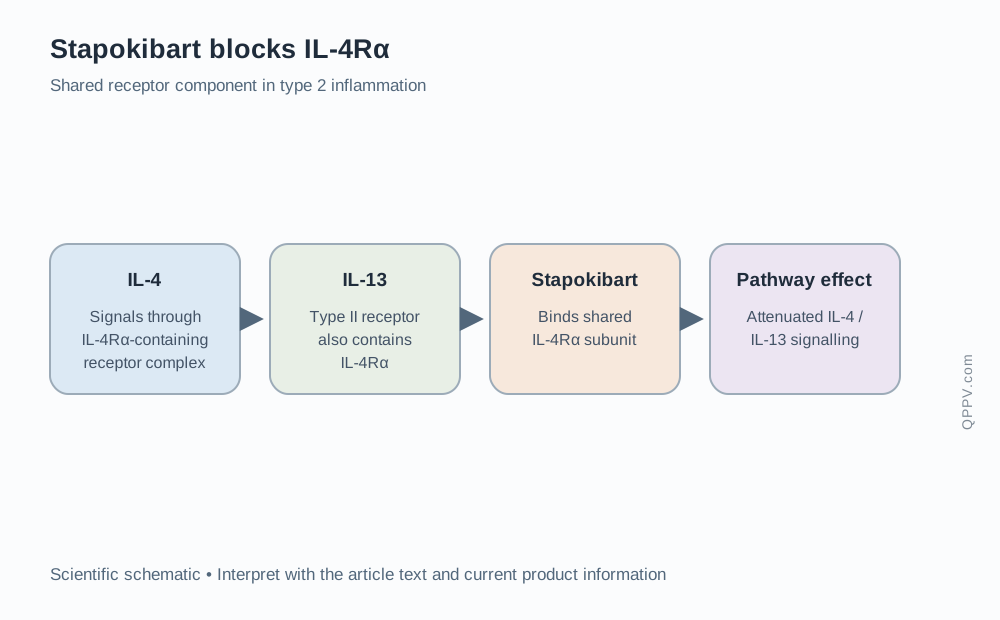
Figure 1. IL-4 and IL-13 use receptor complexes that share IL-4Rα; stapokibart blocks this shared component. The figure simplifies receptor assembly and intracellular signalling.
Development evidence and authorised use
A multicentre, randomised, double-blind, placebo-controlled phase 3 study (CM310AD005) evaluated stapokibart in adults with moderate-to-severe atopic dermatitis. In the 16-week induction period, participants received stapokibart or placebo; subsequent follow-up included an open-label treatment period. A 52-week publication reported maintained clinical responses during continued treatment, but open-label extension estimates are affected by retention, treatment switching and the lack of a concurrent placebo comparator throughout follow-up. [2,3]
Reported outcomes include Eczema Area and Severity Index (EASI) response, Investigator Global Assessment and itch numerical-rating-scale response. In the pivotal study, EASI-75 at week 16 was reported in 66.9% of the stapokibart group versus 25.8% with placebo. At week 52, reported response proportions among the study’s follow-up groups were high; interpretation must account for the extension design rather than treating these percentages as a controlled long-term comparison. [3]
The NMPA notice identifies the authorised adult population but does not provide all product-information details. Dosing, contraindications, pregnancy/lactation language, vaccination advice and reporting instructions must therefore be verified in the current Chinese label. Do not import another IL-4Rα antibody’s dose or wording into stapokibart materials.
Safety profile and pharmacovigilance
Controlled and extension studies inform tolerability in the studied atopic dermatitis population, but public abstracts and NMPA notices do not equal a complete label-level safety database. Describe an observed event with its study source and denominator where available. Distinguish stapokibart-specific findings from established class considerations such as ocular surface symptoms or infection susceptibility unless product-specific evidence confirms the association.
For case evaluation, capture baseline disease severity, skin infection history, prior biologic or immunosuppressive treatment, concomitant topical therapy, dose and timing, symptom change, rescue medication and outcome. A worsening rash may represent uncontrolled dermatitis, infection, contact dermatitis, treatment-emergent disease or another diagnosis; clinical assessment is essential.
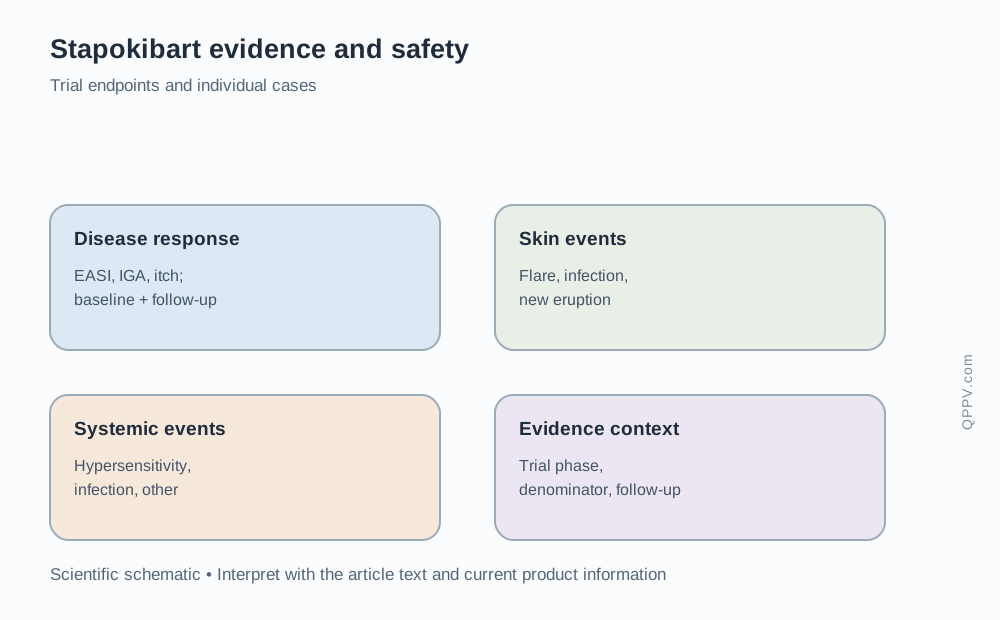
Figure 2. Evidence and safety domains for case review. It separates trial endpoints from individual events and does not prescribe a universal monitoring schedule.
Practical pharmacovigilance
Event documentation
Record the treatment indication and severity, body-surface involvement where available, prior and concomitant therapy, dosing history and the interval between exposure and event. For suspected hypersensitivity, document timing, skin and systemic findings, treatment and outcome. For infections, capture site, pathogen testing, severity and whether treatment was interrupted. For ocular symptoms, preserve the specific complaint and assessment rather than using a broad “eye disorder” description.
Lack of response can be clinically relevant even when it is not an adverse reaction. Record the instrument and threshold used, such as EASI, Investigator Global Assessment or itch score, as well as missing data and rescue therapy. Avoid comparing scores collected with different methods as if they were interchangeable.
Aggregate review and governance
Review adverse events with exposure, follow-up duration and study design in view. Separate randomised induction-period evidence from open-label extension data and real-world reports. Assess whether a pattern is product-specific, consistent with IL-4Rα pathway blockade, or potentially due to the underlying disease and its treatments. Any class-based inference should be labelled as such.
The marketing-authorisation holder should reconcile literature, trial and spontaneous-report sources in line with applicable local requirements. Keep the current Chinese label and NMPA safety communications under controlled review. When evidence changes, document what changed, the affected population, the uncertainty and the action taken.
Key takeaways
- Stapokibart binds IL-4Rα and attenuates signalling through pathways used by both IL-4 and IL-13.
- China NMPA approval applies to the adult population specified in the NMPA notice.
- Phase 3 evidence includes controlled induction and longer follow-up; extension results require design-aware interpretation.
- Do not transfer another antibody’s label, dose or warning to stapokibart.
- Capture disease activity, prior therapy, concomitant treatment, event phenotype and treatment outcome.
References
- National Medical Products Administration of China. Stapokibart injection approved for marketing. https://english.nmpa.gov.cn/2025-02/19/c_1073576.htm
- Zhao Y, et al. Efficacy and safety of stapokibart (CM310) in adults with moderate-to-severe atopic dermatitis: phase 3 trial. J Am Acad Dermatol. 2024. PMID: 39038559. https://pubmed.ncbi.nlm.nih.gov/39038559/
- Zhao Y, et al. Long-term efficacy and safety of stapokibart for moderate-to-severe atopic dermatitis: 52-week results from a phase 3 trial. Allergy. 2025. PMID: 39450683. https://pubmed.ncbi.nlm.nih.gov/39450683/
- Pharmacokinetics, pharmacodynamics, safety and tolerability of stapokibart in healthy volunteers and adults with atopic dermatitis. PMID: 38833140. https://pubmed.ncbi.nlm.nih.gov/38833140/
Regulatory Note
Regulatory information was checked on 25 September 2026. The described indication is the China NMPA scope in its published notice. Other jurisdictions may have different or no authorisation. Consult current local product information for dosing, warnings, contraindications, pregnancy advice and reporting obligations.