Trastuzumab and Hyaluronidase Subcutaneous Formulation: Administration, Safety and Pharmacovigilance
Subcutaneous trastuzumab combined with recombinant human hyaluronidase is not simply intravenous trastuzumab delivered by another route. The active HER2-directed antibody is the same biological principle, but the medicinal product has a different concentration, fixed-dose administration model, injection procedure and route-specific adverse-reaction profile. These differences matter to pharmacovigilance because the principal new risks arise from product selection, route, preparation and administration, rather than from a new molecular target.
This article therefore complements the molecule-level trastuzumab article rather than repeating its HER2 biology and established systemic safety profile.
- Trastuzumab and Hyaluronidase Subcutaneous Formulation: Administration, Safety and Pharmacovigilance
- Product Concept and Classification
- Why Route Changes the Pharmacovigilance Problem
- Clinical Use and Administration Architecture
- Safety Profile in Practice
- Case Assessment
- Signal Detection and Aggregate Review
- Practical Pharmacovigilance Controls
- Inspection and Governance Considerations
- Key Takeaways
- References
- Regulatory Note
Product Concept and Classification
The formulation combines trastuzumab with recombinant human hyaluronidase. Hyaluronidase transiently depolymerises hyaluronan in subcutaneous tissue, increasing local permeability and allowing a relatively large injection volume to disperse and be absorbed. This is a formulation-enabling function; hyaluronidase does not provide the antitumour effect.
The product is therefore best classified across several dimensions:
| Dimension | Classification | PV implication |
|---|---|---|
| Therapeutic antibody | HER2-directed humanised IgG1 | Parent trastuzumab safety remains relevant |
| Formulation component | Recombinant hyaluronidase | Enables subcutaneous dispersion; adds local tolerability considerations |
| Route | Subcutaneous | Injection-site and administration reactions become prominent |
| Dose model | Fixed dose in the U.S. formulation | Avoids weight calculation but increases wrong-product/wrong-route error potential |
| Product identity | Distinct presentation from IV trastuzumab | Brand, strength, route and batch traceability are essential |
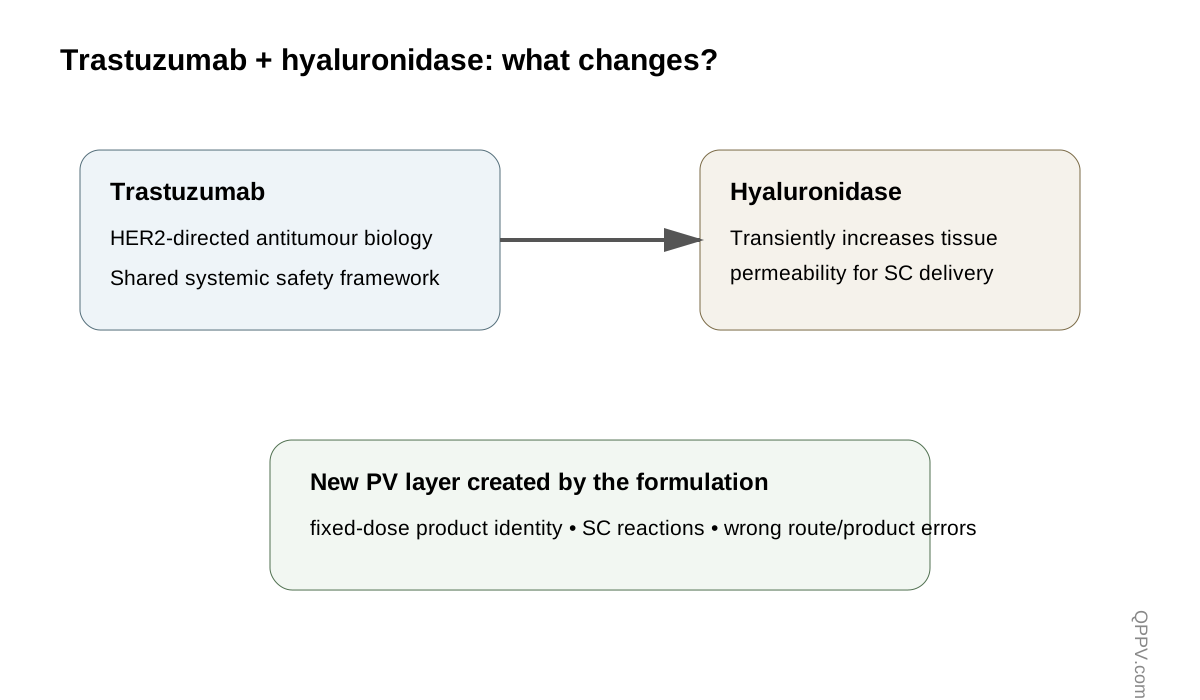
Figure 1. The subcutaneous formulation retains trastuzumab's HER2-directed pharmacology while adding a hyaluronidase-enabled route and a separate administration/error pathway.
Why Route Changes the Pharmacovigilance Problem
Intravenous trastuzumab concentrates operational risk around infusion preparation, infusion reactions and weight-based dosing. A fixed-dose subcutaneous presentation removes some of those steps, but replaces them with different controls: correct presentation selection, subcutaneous-only administration, site management and recognition of injection-related reactions.
A useful PV distinction is therefore between molecule-level risks, which follow trastuzumab across formulations, and presentation-level risks, which arise because the formulation and route differ.
Shared molecule-level risks
Cardiac dysfunction, embryo-fetal toxicity and hypersensitivity remain relevant because the patient is still exposed to trastuzumab. These risks should be assessed using the parent molecule's established clinical framework.
Formulation-level risks
The formulation creates additional questions: Was the correct subcutaneous product selected? Was it confused with an intravenous vial? Was the complete dose administered? Was the event local or systemic? Did symptoms occur during or after the injection? These details can materially change case interpretation.
Clinical Use and Administration Architecture
In the United States, the subcutaneous trastuzumab-hyaluronidase presentation is supplied as a fixed 600 mg trastuzumab dose with hyaluronidase in 5 mL for subcutaneous injection. This differs fundamentally from intravenous trastuzumab, where dose is typically weight based. Pharmacovigilance case intake should therefore capture the exact presentation rather than recording only “trastuzumab.”
Route switching also requires care. A patient may receive intravenous trastuzumab at one stage of treatment and a subcutaneous presentation later. Exposure chronology should identify the actual formulation at each dose because an injection-site reaction or administration error cannot be meaningfully assessed from the active-substance name alone.
Safety Profile in Practice
Administration and injection-site reactions
Local pain, erythema, swelling and other injection-site reactions are expected route-specific events. Systemic administration-related reactions can also occur. Case assessment should distinguish local injection phenomena from systemic hypersensitivity or reactions consistent with trastuzumab itself.
Cardiac dysfunction
The subcutaneous route does not remove trastuzumab's potential for left-ventricular dysfunction. Cardiac assessment therefore follows the same biological reasoning as for intravenous trastuzumab: baseline cardiac status, concomitant or prior anthracyclines, serial LVEF information, symptoms, interruption and recovery are more informative than route alone.
Embryo-fetal risk
Pregnancy exposure remains a trastuzumab exposure. Route should be documented, but it does not materially alter the core embryo-fetal risk framework.
Product and route errors
The most preventable PV failures are often operational. These include selection of the wrong trastuzumab presentation, attempting to use an intravenous product subcutaneously, incorrect assumptions that fixed-dose and weight-based regimens are interchangeable, incomplete administration and documentation that omits route.
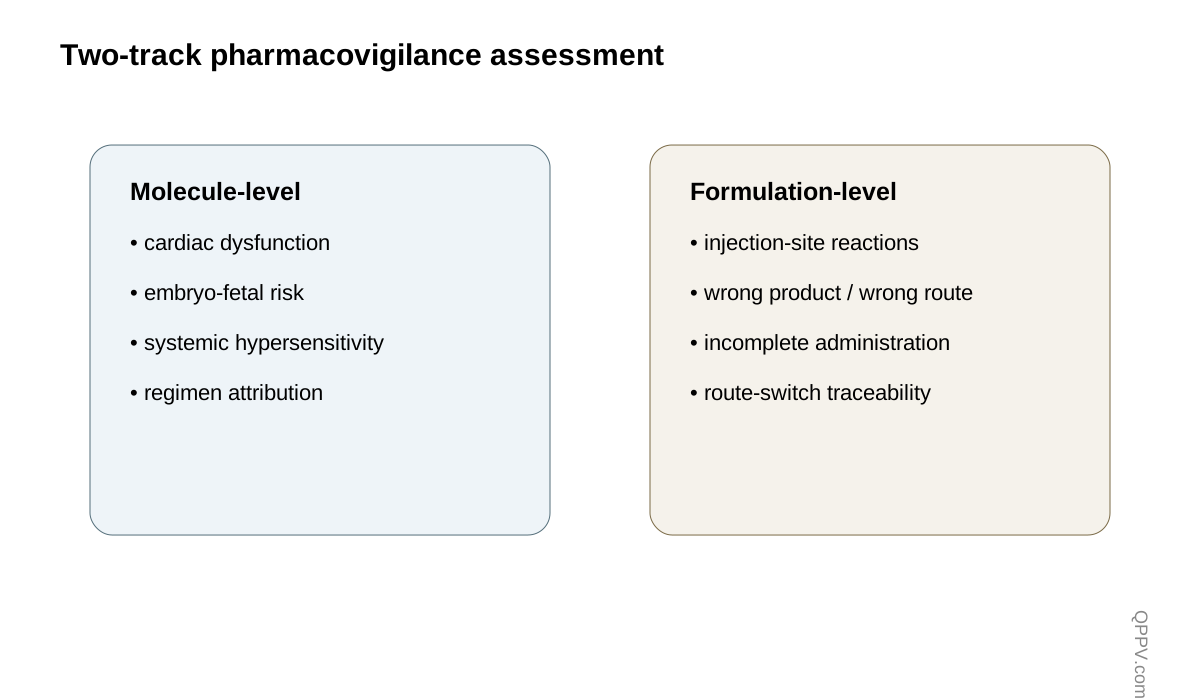
Figure 2. Subcutaneous trastuzumab requires simultaneous surveillance of established trastuzumab risks and formulation-specific administration, route and product-selection risks.
Case Assessment
A useful follow-up structure is:
| Question | Why it matters |
|---|---|
| Exact product/presentation and batch? | Confirms traceable exposure |
| Subcutaneous or intravenous route? | Identifies the relevant administration pathway |
| Dose, date, site and completeness of injection? | Supports error and local-reaction assessment |
| Previous trastuzumab formulation? | Helps identify route-switch context |
| Timing and nature of reaction? | Distinguishes local, administration-related and systemic events |
| Cardiac history/LVEF where relevant? | Supports parent-molecule risk assessment |
| Concomitant chemotherapy or HER2 therapy? | Addresses alternative causes and regimen attribution |
Signal Detection and Aggregate Review
Formulation-specific analyses should not be diluted into a single trastuzumab pool when the question concerns injection reactions or medication errors. Conversely, systemic events such as cardiac dysfunction may require integrated review across trastuzumab presentations, with stratification by formulation where relevant. The correct analytical unit therefore depends on the safety question.
Practical Pharmacovigilance Controls
Operationally, the strongest controls are simple: preserve formulation identity in safety databases, make route a mandatory case-assessment field where multiple presentations exist, distinguish fixed-dose subcutaneous exposure from weight-based intravenous dosing, and trend administration errors separately from expected local reactions.
An illustrative failure mode is a case coded only as “trastuzumab administration reaction” when the source describes a painful abdominal injection after a formulation switch. Without route and product identity, the case may be pooled with infusion reactions and the local tolerability signal becomes invisible.
Inspection and Governance Considerations
An inspector could reasonably examine whether the pharmacovigilance system can reconstruct which trastuzumab presentation a patient received; whether medication-error coding differentiates wrong product, wrong route and wrong dose; whether local reactions are analysed at presentation level; and whether aggregate reviews explain when data are pooled across formulations and when they are stratified.
Key Takeaways
Subcutaneous trastuzumab-hyaluronidase is pharmacologically linked to trastuzumab but operationally distinct from intravenous trastuzumab. The main added PV value comes from route-specific reaction assessment, fixed-dose versus weight-based product differentiation, medication-error surveillance and presentation-level traceability. Shared systemic trastuzumab risks should remain integrated with the parent molecule's safety framework.
References
- Genentech. Herceptin Hylecta (trastuzumab and hyaluronidase-oysk): Information for Healthcare Providers and Full Prescribing Information. Current online product information accessed September 2026.
- U.S. Food and Drug Administration. Herceptin Hylecta prescribing information and regulatory history. Drugs@FDA.
- European Medicines Agency. Herceptin (trastuzumab): EPAR and product information. Current product information.
- QPPV.com. Trastuzumab: Classification, History, Mechanism of Action, Safety and Pharmacovigilance. Parent molecule reference article.
Regulatory Note
The detailed formulation and dosing discussion in this article uses the U.S. trastuzumab-hyaluronidase presentation as the product-specific regulatory anchor. Trastuzumab subcutaneous presentations, strengths, names and authorised uses differ by jurisdiction. Local approved product information should therefore be checked before applying route, dose or administration details operationally.