WHO Smart Pharmacovigilance: What WHA79.11 Means for Global Safety Systems
- WHO Smart Pharmacovigilance: What WHA79.11 Means for Global Safety Systems
- Introduction
- 1. What WHA79.11 is and is not
- 2. Why a systems approach is necessary
- 3. Integration of vigilance systems
- 4. Patient and caregiver reporting
- 5. Regulatory capacity and workforce
- 6. Real-world evidence and safety assessment
- 7. Artificial intelligence and pharmacovigilance
- 8. Data quality and interoperability
- 9. International collaboration, reliance and work-sharing
- 10. Risk communication and health literacy
- 11. Resilience and health emergencies
- 12. Translating the resolution into system capability
- 13. Implications for EU pharmacovigilance
- 14. Governance and evidence of effectiveness
- 15. Illustrative inspection questions
- 16. Practical implementation sequence
- 17. Key Takeaways
- Checklist for pharmacovigilance leaders
- References
- Regulatory Note
Introduction
Pharmacovigilance depends on more than individual case reports. Patients need usable reporting routes, information must move between organisations, regulators need adequate expertise, data must be interpretable, and safety information must reach decision-makers and the public. The World Health Assembly addressed this wider systems question in May 2026 through resolution WHA79.11, “Advancing smart, efficient pharmacovigilance as an essential tool for robust, sustainable, resilient and responsive health systems, for everyone, everywhere.” [1]
The resolution urges Member States to integrate vigilance systems, strengthen patient and consumer reporting, modernise national pharmacovigilance, build regulatory and workforce capacity and, where appropriate, extend vigilance principles beyond medicines and vaccines. It also asks WHO to continue developing normative guidance and technical tools that consider real-world evidence and the ethical use of artificial intelligence. [1]
WHA79.11 does not create a single global pharmacovigilance law. Its operative provisions are directed principally to Member States and to the WHO Director-General. National legislation and regional regulatory frameworks remain the instruments that create binding obligations in particular jurisdictions. Its significance is strategic: it gives global policy endorsement to a more integrated, data-capable, participatory and resilient model of safety surveillance.
The resolution should be read with WHO’s Global Smart Pharmacovigilance Strategy, published in 2025. The strategy provides the broader framework; WHA79.11 gives that direction political endorsement and requests continued technical development. [2]
1. What WHA79.11 is and is not
A World Health Assembly resolution is an instrument of the WHO governing body. WHA79.11 “urges” Member States to act according to national contexts and priorities and “requests” actions from the Director-General. [1] It is therefore not equivalent to an EU regulation, directive, national medicines law or marketing-authorisation condition.
A company should not write a procedure stating that WHA79.11 itself requires an MAH to perform a particular operational step unless another applicable instrument creates that obligation.
| Instrument | Main function | Status for an EU MAH |
|---|---|---|
| EU legislation | Creates binding obligations within its scope | Binding where applicable |
| EU GVP | Explains implementation of the EU system | Apply according to legal/guidance status |
| National requirements | Implement jurisdiction-specific obligations | Binding where applicable |
| WHA79.11 | Sets global policy direction | Not an EU MAH legal requirement by itself |
| WHO Smart Pharmacovigilance Strategy | Global technical and strategic framework | Reference, not EU legislation |
| Company procedures | Translate requirements into controlled operations | Internally binding once adopted |
The resolution can nevertheless influence national policy, capacity building, international cooperation and future technical guidance. For global companies it is also a useful benchmark for assessing whether the architecture of a safety system can support changing evidence sources and regulatory expectations.
2. Why a systems approach is necessary
WHO’s 2025 strategy describes pharmacovigilance as part of the wider lifecycle system protecting confidence in medicines, vaccines and other health products. It identifies fragmentation, under-resourcing and weak connections with health infrastructure as system problems and promotes risk-based prioritisation, reliance, integration and measurement of system performance. [2]
No single safety activity can compensate for failures elsewhere. Better signal detection cannot correct systematic under-reporting. A large database cannot compensate for poor data quality. A sophisticated model cannot turn biased data into unbiased evidence.
WHA79.11 therefore connects several capabilities rather than proposing a technology project:
accessible reporting → integrated vigilance → governed data and evidence → responsible analysis → assessment and action
with workforce, governance, international collaboration and resilience supporting the whole system.
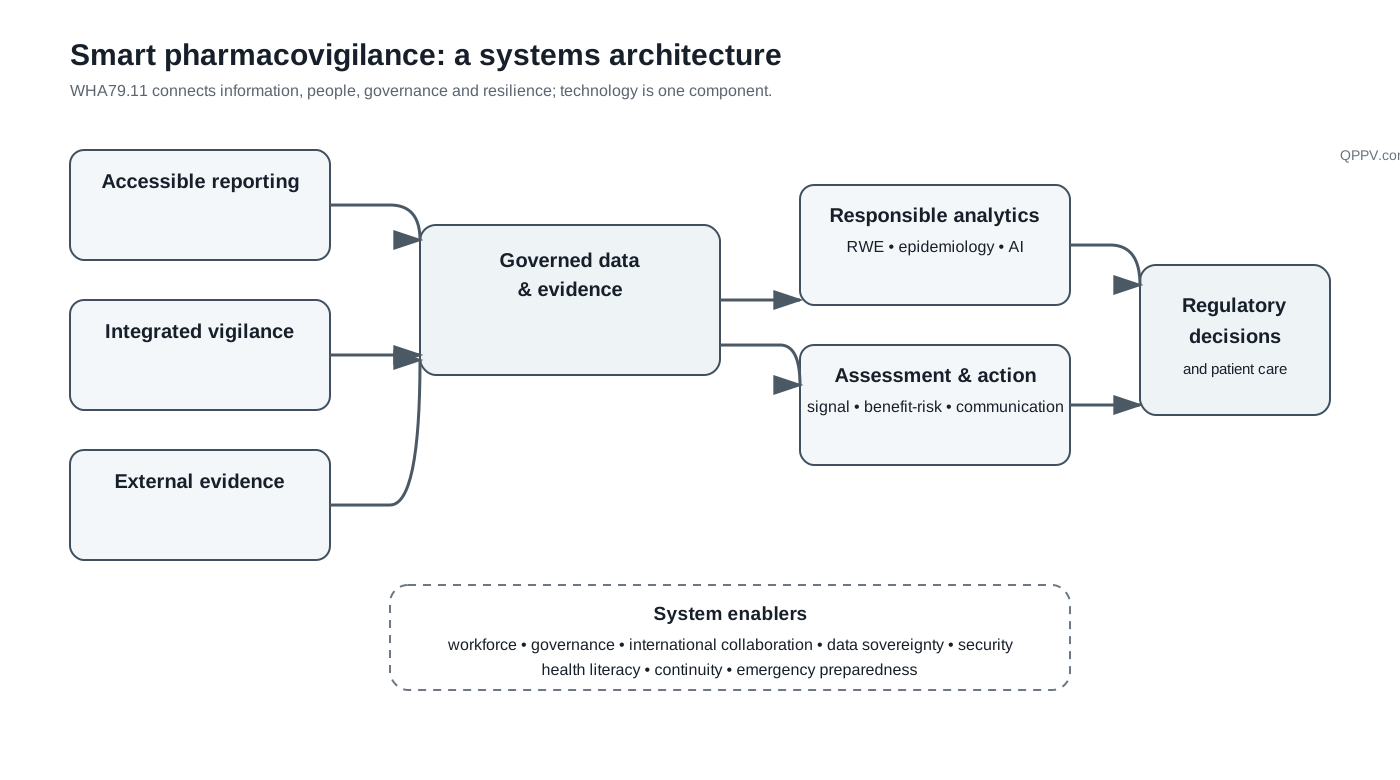
Figure 1. Smart pharmacovigilance as a systems architecture. This conceptual model represents relationships emphasised by WHA79.11; it is not a WHO compliance checklist.
3. Integration of vigilance systems
The resolution urges Member States to drive integration of vigilance systems so that vigilance data and evidence can be used more comprehensively for regulation and patient care. [1]
Integration does not mean putting every data source into one database or treating every source as equivalent. Spontaneous reports, solicited reports, registries, clinical studies and other real-world data have different generating processes and evidentiary limitations.
The useful concept is functional integration: information should be connectable where doing so improves detection, assessment, decision-making or communication, while preserving the distinctions needed for valid interpretation.
For a mature organisation, relevant interfaces include case processing and signal management; product quality and pharmacovigilance; clinical development and post-authorisation surveillance; medical information and safety intake; epidemiology and safety assessment; regulatory intelligence and safety governance; and global and local safety operations.
Integration therefore requires an evidence model. A spontaneous-report signal may generate a hypothesis but does not normally establish incidence or causality on its own. An epidemiological study can address a comparative-risk question but remains dependent on exposure and outcome definitions, comparator selection, follow-up and control of bias. A smart system connects evidence streams without erasing their methodological differences.
4. Patient and caregiver reporting
WHA79.11 specifically calls for stronger patient or consumer reporting systems so that patients and caregivers can easily report adverse events to health authorities or institutions. It also calls for education and awareness about recognising and reporting events. [1]
This is a chain of capabilities rather than simply an online form. A person must be able to recognise that an event may be relevant, locate a reporting route, provide information without disproportionate difficulty and have the information handled appropriately. The receiving organisation then needs processes for validation, follow-up, coding, duplicate management, data protection and appropriate use in the wider safety system.
Health literacy is therefore part of pharmacovigilance capacity. A technically available reporting channel has limited value if intended users do not understand when or how to use it.
For MAHs, the direction reinforces the need to understand the complete source ecosystem. Safety information may arrive through direct reports, patient support programmes, medical-information contacts, digital services, social media, product complaints or partners. Applicable legislation and GVP determine which information must be handled as suspected adverse reactions; WHO provides the wider systems rationale for accessible reporting.
5. Regulatory capacity and workforce
WHA79.11 calls for stronger national systems, adequate governance and financing, and human-resource capacity. [1] Pharmacovigilance quality depends heavily on people who can interpret evidence.
Capability is needed across clinical assessment, case processing, epidemiology, statistics, signal management, benefit-risk evaluation, regulatory science, information technology, data governance and communication. A regulator may need specialists to evaluate signals and safety studies; healthcare professionals need reporting awareness; patients need usable reporting channels; and data specialists need enough pharmacovigilance knowledge to understand what an analytical output does and does not establish.
For an MAH, workforce planning should follow the safety questions the organisation must answer. Introducing advanced analytics without sufficient clinical, regulatory and methodological expertise can create apparent sophistication without better decisions.
6. Real-world evidence and safety assessment
WHA79.11 asks WHO to develop or update normative guidance and technical tools for smart pharmacovigilance while considering real-world evidence. [1] This aligns with the WHO strategy’s broader emphasis on modern, risk-based systems. [2]
Real-world evidence is valuable because post-authorisation use exposes products to larger and more heterogeneous populations than many pre-authorisation studies. Long-term exposure, comorbidities, concomitant medicines, pregnancy, age and actual utilisation patterns may reveal questions that were difficult to characterise before authorisation.
The availability of data does not remove the need for study design. Safety questions still require suitable exposure and outcome definitions, an appropriate population and comparator, adequate follow-up and attention to confounding, missingness and other bias.
The operational sequence is therefore:
safety question → evidence requirement → appropriate study/data source → analysis → interpretation → action
Real-world data should complement rather than automatically replace spontaneous reporting, clinical evidence or established pharmacovigilance activities.
7. Artificial intelligence and pharmacovigilance
The resolution explicitly refers to the ethical use of artificial intelligence for pharmacovigilance. [1] This places AI within governance rather than treating it as an objective in itself.
AI may support literature screening, information extraction, case intake, duplicate detection, coding assistance, signal prioritisation or evidence synthesis. Whether a use is appropriate depends on its purpose, risk, validation, human oversight, data quality and applicable requirements.
A key distinction is between decision support and decision replacement. A model can help prioritise information for human review without independently determining causality, seriousness, reportability or regulatory action.
Governance should address intended use, risk, training and evaluation data, representativeness, bias, robustness, versioning, change control, auditability, human review, privacy, security and performance monitoring. The resolution does not prescribe a single AI validation method. Its importance is that responsible AI use is explicitly part of the global pharmacovigilance agenda.
8. Data quality and interoperability
WHA79.11 asks WHO to support data quality and interoperability and equitable participation of Member States, including developing countries, while respecting data sovereignty and security. [1]
Interoperability has technical, semantic and process dimensions. Systems must be able to exchange information; exchanged fields must retain consistent meaning; and organisations must understand when information is exchanged, who owns the next action and how exceptions are managed.
Two systems may successfully exchange an adverse-event message while still representing products, events, dates or patient characteristics differently. Technical connectivity alone is therefore not sufficient.
Data-quality controls should address accuracy, completeness, consistency, timeliness, provenance, duplicate management, coding and traceability. Quality should be assessed across system boundaries, not only inside the safety database.
Equity also matters. A global surveillance model that systematically excludes countries with weaker infrastructure or fewer specialists can produce an incomplete picture of safety. Modernisation must account for different national capabilities.
9. International collaboration, reliance and work-sharing
WHA79.11 asks WHO to strengthen international collaboration, information sharing, reliance and work-sharing. [1]
Safety concerns cross borders, while regulatory resources and analytical expertise are unevenly distributed. Structured reliance can reduce duplicated work and allow authorities to benefit from another authority’s assessment while retaining responsibility for local decisions.
Reliance does not mean automatic adoption of another regulator’s conclusion. It requires confidence in the source, defined responsibilities, access to relevant evidence and consideration of contextual differences.
The same principle applies within global companies. A central safety function can coordinate evidence and prevent duplicated assessments, but local teams still need to understand local reporting rules, labels, risk-management measures and regulatory decisions. The mature model is coordinated rather than artificially uniform.
10. Risk communication and health literacy
WHA79.11 links pharmacovigilance with health literacy and efforts to counter misinformation and disinformation. [1] WHO’s communication on the resolution also highlighted timely signal detection, effective risk communication and lessons from health emergencies. [3]
Risk communication is not simply public relations. It should describe what is known, the limitations and uncertainty of the evidence, the clinical meaning and any action required.
A useful communication framework separates observed evidence, strength and limitations, clinical interpretation, uncertainty, recommended action and the route by which new information will be received and assessed. Ambiguous internal safety communication can also alter reporting, signal prioritisation and medical-information responses.
11. Resilience and health emergencies
The resolution’s title connects pharmacovigilance with robust, sustainable, resilient and responsive health systems. [1] It also links implementation with health-emergency preparedness.
An emergency can change the operating environment rapidly: exposure may increase, new products may be introduced under pressure, healthcare utilisation can shift and reporting patterns can change.
Resilience is therefore more than recovery of an IT application. A resilient pharmacovigilance system needs continuity arrangements for staffing, reporting channels, data exchange, analytical capacity, communication and decision governance.
For an MAH, business-continuity planning should be connected to pharmacovigilance priorities. A generic disaster-recovery document does not demonstrate that critical safety intake, assessment, follow-up and reporting can continue.
12. Translating the resolution into system capability
WHA79.11 is policy direction, not a company compliance checklist. Its themes can nevertheless be translated into an operational maturity model.
| Capability | Less mature state | More mature state |
|---|---|---|
| Reporting access | Limited or fragmented channels | Accessible patient, HCP and institutional routes with controlled intake |
| Data integration | Manual transfers between isolated systems | Defined interfaces and evidence relationships |
| Data quality | Mainly case-level QC | Cross-system quality metrics, provenance and root-cause management |
| Evidence generation | Predominantly spontaneous reports | Appropriate combination of spontaneous, solicited and epidemiological/RWD evidence |
| Analytics | Mainly manual review | Risk-based advanced analytics with human oversight |
| Workforce | Task-specific training | Multidisciplinary clinical, regulatory, epidemiological and data capability |
| Collaboration | Ad hoc information exchange | Structured reliance, work-sharing and information networks |
| Communication | Mainly reactive | Evidence-based communication linked to uncertainty and action |
| Resilience | Generic continuity plan | Tested continuity of critical PV functions |
| Governance | Activity monitoring | System performance, accountability and continuous improvement |
The table is an operational interpretation, not a WHO standard. Organisations should map these capabilities to the legal and regulatory requirements that actually apply to them.
13. Implications for EU pharmacovigilance
The EU already has many capabilities emphasised by WHA79.11: EudraVigilance reporting, signal management, risk-management systems, post-authorisation studies, pharmacovigilance inspections and defined MAH and competent-authority responsibilities. GVP Module VI provides guidance on collection, management and submission of suspected adverse reactions, while EU legislation establishes underlying legal duties. [4–7]
The global development remains relevant in three ways.
First, safety oversight is increasingly system-oriented. Global organisations should be able to demonstrate how evidence sources, operational functions and governance connect rather than only showing that individual procedures exist.
Second, data and analytical capability are governance subjects. AI and advanced real-world-data methods should be connected to validation, quality management, change control, human oversight and accountability.
Third, global convergence does not remove jurisdictional differences. A global safety process must establish common principles while preserving local legal and regulatory requirements.
WHA79.11 is therefore strategic context for EU professionals, not a substitute for EU legislation or GVP.
14. Governance and evidence of effectiveness
A mature pharmacovigilance system should demonstrate not merely that activities occur, but that they work together.
Evidence may include defined ownership of major safety-data sources; documented interfaces and reconciliation; data-quality standards and trend monitoring; validation and change-control records for critical systems; competency records; governance for AI and advanced analytics; evidence-generation plans linked to safety questions; decision records showing how multiple evidence streams were considered; safety-communication records; continuity testing; and leadership or QPPV oversight of system performance.
The governing principle is familiar from pharmacovigilance quality systems: the organisation should be able to demonstrate what it intended to do, what happened, how deviations were detected, what impact was assessed and whether corrective action was effective.
15. Illustrative inspection questions
WHA79.11 is not an inspection guideline and should not be used to manufacture inspection findings. Its systems perspective can nevertheless inform hypothetical inspection questions.
An inspector could ask how a company prevents patient-support, medical-information, product-quality and partner processes from becoming disconnected sources of safety information. Other illustrative questions include:
- How are important safety-data interfaces identified and owned?
- How are cross-system data-quality problems detected?
- If an AI tool supports a safety activity, what is its intended use and how is performance controlled?
- How are model changes governed and, where necessary, revalidated?
- How are real-world-data studies linked to the safety questions they address?
- How are global processes mapped against local legal requirements?
- What evidence demonstrates continuity of critical pharmacovigilance functions?
- Which meaningful system-performance measures reach pharmacovigilance leadership and the QPPV?
A technically compliant collection of procedures can still be weak if the organisation cannot demonstrate how its components work together.
16. Practical implementation sequence
A sensible implementation approach begins with the safety system rather than a technology purchase.
Map the ecosystem. Identify major safety sources, systems, vendors, regulatory interfaces and decision forums.
Define the questions. Establish what the system must answer, such as whether a new concern is emerging, whether an existing risk is changing or whether a risk-minimisation measure is effective.
Assess data fitness. Determine whether sources are sufficiently complete, accurate, timely, interpretable and fit for the question.
Establish governance. Define ownership, escalation, human review, validation, change control and accountability.
Introduce advanced methods selectively. Use AI or advanced real-world-data methods when they solve a defined safety problem and their limitations can be controlled.
Measure performance. Assess whether the system produces timely, reliable and decision-useful information rather than simply measuring activity volume.
Test resilience. Exercise plausible disruptions and verify that critical pharmacovigilance functions remain operable.
This sequence avoids equating smart pharmacovigilance with artificial intelligence. Technology is one component of a safety system whose effectiveness depends on evidence, people, governance and decisions.
17. Key Takeaways
WHA79.11 is an important global policy development, but its significance is best understood at system level.
- It is a WHO policy resolution, not a global pharmacovigilance law. Binding requirements continue to come from applicable national, regional and product-specific legal instruments.
- Integration is central. Vigilance systems, data, evidence, expertise and decision-making should connect more effectively.
- Patients and caregivers are part of safety infrastructure. Accessible reporting and health literacy are system capabilities.
- Real-world evidence and AI are explicit parts of the future direction. Their value depends on methodological and governance controls.
- Data quality and interoperability remain foundational. More data are useful only when provenance, meaning and limitations can be understood.
- Reliance and work-sharing can strengthen capacity. Coordination should improve efficiency without assuming identical legal or clinical contexts.
- Resilience is a pharmacovigilance capability. Critical safety functions need to remain effective during disruption and emergencies.
- For EU professionals, WHA79.11 complements rather than replaces EU law and GVP. It is strategic context for improving global systems.
Checklist for pharmacovigilance leaders
- Are major safety-data sources and interfaces known and owned?
- Can the organisation explain how different evidence streams contribute to a safety decision?
- Can patients and healthcare professionals report safety information through accessible channels?
- Are data quality, interoperability and provenance assessed across important interfaces?
- Does the organisation have adequate clinical, regulatory, epidemiological and data expertise?
- Are AI and advanced analytics governed according to intended use and risk?
- Can human oversight of material safety decisions be demonstrated?
- Are global processes mapped against local legal and regulatory requirements?
- Can effective external collaboration and information sharing be demonstrated?
- Are continuity arrangements tested for critical pharmacovigilance activities?
- Do senior leaders and the QPPV receive meaningful system-performance information?
References
- World Health Organization. WHA79.11 — Advancing smart, efficient pharmacovigilance as an essential tool for robust, sustainable, resilient and responsive health systems, for everyone, everywhere. Seventy-ninth World Health Assembly, 23 May 2026.
- World Health Organization. The global smart pharmacovigilance strategy. 7 November 2025. ISBN 978-92-4-011675-7.
- World Health Organization. 79th World Health Assembly adopts resolution to strengthen pharmacovigilance. 24 May 2026.
- European Medicines Agency. GVP Module VI — Collection, management and submission of reports of suspected adverse reactions to medicinal products, Revision 2. EMA/873138/2011 Rev. 2.
- European Medicines Agency / Heads of Medicines Agencies. GVP Module III — Pharmacovigilance inspections, Revision 2. EMA/119871/2012 Rev. 2; effective 10 September 2026.
- European Union. Directive 2001/83/EC on the Community code relating to medicinal products for human use, as amended, particularly Title IX and Article 107.
- European Union. Regulation (EC) No 726/2004, as amended.
- European Union. Commission Implementing Regulation (EU) No 520/2012 on pharmacovigilance activities, as amended by Commission Implementing Regulation (EU) 2025/1466.
Regulatory Note
WHA79.11 provides global policy direction and requests actions by WHO and Member States. It is not, by itself, a directly applicable EU legal requirement for marketing authorisation holders. EU pharmacovigilance obligations must be determined from applicable EU legislation, implementing legislation, marketing-authorisation conditions and relevant EMA/GVP guidance.
The maturity model, implementation sequence and inspection questions in this article are operational interpretations or recommended practice, not WHO compliance requirements. They should not be presented as legal obligations.
This article was reviewed against current WHO and EU sources available on 5 October 2026.