Additional Pharmacovigilance Activities in the EU Risk Management Plan
- Additional Pharmacovigilance Activities in the EU Risk Management Plan
Introduction
Routine pharmacovigilance is the foundation of post-authorisation safety monitoring. It includes collection and management of suspected adverse-reaction reports, signal management, literature monitoring, periodic safety evaluation and communication of important safety information. These activities apply broadly across medicinal products, although their exact scope and intensity depend on the product and its regulatory setting.
Routine pharmacovigilance does not answer every safety question. A product may have limited exposure in a population, incomplete information about a clinically important risk, uncertainty about the frequency or modifiers of an event, or a safety concern that requires structured evidence beyond spontaneous reporting. In those circumstances, an additional pharmacovigilance activity may be included in the risk-management system.
The phrase additional pharmacovigilance activity is an operational description rather than a single independent regulatory procedure. Within the EU framework, the activity may be documented in the pharmacovigilance plan of the Risk Management Plan (RMP), in the post-authorisation safety study part of the RMP where applicable, or in another regulatory commitment or controlled programme. The activity must be linked to a defined safety question and to the safety concern or missing-information issue that generated that question.
The place of additional activities in the EU risk-management system
Routine and additional pharmacovigilance
Routine pharmacovigilance is not a weak version of additional pharmacovigilance. It is the continuing system that detects and evaluates safety information across the product lifecycle. An additional activity is justified only when routine sources and analyses are not sufficient to answer a specific question or reduce an important uncertainty.
| Question | Routine pharmacovigilance | Additional activity |
|---|---|---|
| Purpose | Continuing surveillance and evaluation | Resolve or reduce a defined uncertainty |
| Applicability | Forms part of the ongoing PV system | Product-, population- or risk-specific |
| Trigger | Normal PV operation | Evidence gap or regulatory requirement |
| Output | Ongoing detection and assessment | A defined question, evidence output or decision |
| Governance | PV quality system | Study or programme governance plus PV oversight |
The categories may overlap. A PASS may generate cases for routine processing; a registry may support signal detection and exposure estimation; and a drug-utilisation study may assess implementation of a risk-minimisation measure. Purpose, design, governance and traceability determine the distinction.
Safety concern and question
GVP Module V distinguishes important identified risks, important potential risks and missing information. Not every uncertainty becomes an important safety concern, and not every concern requires an additional study.
A useful question statement identifies the population or exposure, the event or outcome, the remaining uncertainty, why routine PV cannot resolve it adequately, the evidence required and the decision that the evidence may inform. “Monitor safety” is not a sufficient objective. “Estimate the incidence and clinical outcome of serious hepatic events in patients with moderate hepatic impairment during routine use, and assess whether the observed pattern changes the current risk characterisation” is more useful because it identifies the population, outcome and decision context. This example is illustrative and does not imply that a particular study is required.
RMP documentation
The RMP should explain the relationship between the safety concern, the activity and the intended use of its results. The pharmacovigilance plan should describe relevant additional activities, their objectives and their contribution to characterising the safety profile. Where a non-interventional PASS is imposed or otherwise required under the applicable framework, the study belongs in the relevant RMP section and must follow the applicable submission and reporting requirements.
The RMP is not the study protocol. It is the regulatory explanation of the risk-management system. The protocol, statistical analysis plan, contracts, approvals, data-management documents and reports provide operational detail. These documents should remain consistent without copying every technical detail into the RMP.
Summary
An additional pharmacovigilance activity is justified by an evidence question, not by the desire to add a study to an RMP. The activity should sit within the risk-management system, use a design appropriate to the uncertainty, have a defined output and remain connected to the decision it is intended to inform.
Choosing the activity
Match the method to the uncertainty
The method should follow the information gap:
| Information need | Possible activity | Important limitation |
|---|---|---|
| Estimate exposure or prescribing context | Drug-utilisation study or database analysis | Exposure may not equal actual use or adherence |
| Characterise incidence or risk factors | Cohort, registry or database study | Confounding, outcome validity and denominator quality |
| Explore a rare clinical outcome | Case-control, registry or linked-data study | Small numbers and ascertainment bias |
| Characterise use in a special population | Registry, targeted cohort or structured follow-up | Generalisability may be limited |
| Assess knowledge or behaviour | Survey, interview or utilisation study | Reported knowledge may not predict actual behaviour |
| Obtain information missing from spontaneous reports | Targeted follow-up or structured data collection | Feasibility and reporter burden |
| Evaluate an RMM | PASS or effectiveness study | Process evidence does not necessarily establish outcome reduction |
These are possible approaches, not automatic design requirements. A study may address several questions, but combining objectives can make design and interpretation unclear. The protocol should distinguish primary and secondary objectives and identify which results will support which decision.
Post-authorisation safety studies
A PASS is a study conducted to obtain further information on the safety of a medicinal product or to measure the effectiveness of risk-management measures. GVP Module VIII distinguishes imposed and non-imposed PASS and provides requirements and recommendations for protocols, amendments, reports, registration and oversight.
The choice of design depends on the question. Possible designs include descriptive studies, cohort studies, case-control studies, database studies, surveys, chart reviews and other interventional or non-interventional approaches where scientifically justified. The label PASS does not itself establish scientific quality; the design must be capable of answering the question with acceptable validity and feasibility.
Registries and structured data collection
A registry may provide longitudinal information about a disease, exposure, treatment or outcome. It may be useful when the question concerns a defined population, a rare event, treatment during pregnancy, a product class or a clinical characteristic not captured consistently in spontaneous reports.
A registry is not automatically representative of all exposed patients. Coverage, inclusion criteria, follow-up, missing data, duplicate enrolment, outcome validation and changes in clinical practice should be addressed. The RMP should explain why the registry is suitable for the question and how its limitations will be handled.
Drug-utilisation and exposure studies
Exposure estimates and prescribing patterns can be necessary to interpret the frequency and context of a safety concern. Drug-utilisation studies may examine indication, dose, duration, population, contraindications, co-medication or adherence to conditions of use.
A utilisation study is not the same as an effectiveness evaluation. It may show whether a measure was implemented or whether prescribing changed, but it may not demonstrate that the clinical risk was reduced. The distinction should be explicit when the activity supports an RMP conclusion.
Enhanced or targeted surveillance
Enhanced surveillance may involve additional follow-up, targeted collection of information, a defined reporting pathway, laboratory monitoring or focused review of a population or event. It should not be described vaguely. The organisation should define what is enhanced, for whom, for how long, what information is collected and how the information will change the assessment.
Enhanced follow-up is useful only if the requested information is clinically meaningful and can be collected reliably. Excessive requests can burden reporters without reducing uncertainty. The activity should therefore be proportionate to the question and expected value of the information.
Design and implementation
Feasibility is part of scientific justification
A scientifically attractive design may be infeasible because the population is too small, data are unavailable, outcomes cannot be validated, follow-up is incomplete or the healthcare setting cannot support the required collection. Feasibility should therefore be assessed before a commitment is made.
The assessment should address population size and exposure, data sources and linkage, outcome ascertainment, comparator information where relevant, confounding and bias, follow-up and loss to follow-up, site capability, data protection, participation burden, analysis capacity, milestones and alternative designs.
A negative feasibility result is not a failure of pharmacovigilance. It may show that the original question needs refinement or another method is more appropriate. The decision and rationale should be documented.
Protocol, analysis and safety interface
The protocol should translate the RMP question into operational terms. Depending on the activity, it may define the population, exposure, comparator, outcomes, data sources, observation period, confounders, analysis populations, statistical methods, missing-data handling, interim analyses, reporting milestones and governance.
The protocol should identify how safety information discovered during the activity enters the ordinary PV system. A study does not create a separate safety universe. Serious adverse reactions, signals and urgent safety information must be assessed and processed under the applicable PV procedures.
A statistical analysis plan should be specified before the primary analysis. Changes made after data review should be documented with their rationale and impact. The analysis should distinguish descriptive findings, estimates with uncertainty, sensitivity analyses and causal interpretation.
Regulatory and ethics interfaces
The regulatory route depends on the design and jurisdiction. For a non-interventional PASS, GVP Module VIII and applicable national requirements govern important procedural steps. Other activities may involve clinical-trial, ethics, data-protection, registry, healthcare or national research requirements. The RMP description is not a substitute for those approvals.
The responsible organisation should determine whether the activity is imposed or non-imposed, whether protocol submission or notification is required, which authority or ethics process applies, whether registration is needed, how amendments are approved, what reports must be submitted and how personal data are governed.
Governance and evidence
Roles and responsibilities
The MAH remains responsible for its pharmacovigilance system when an activity is delegated to a contract research organisation, academic group, registry operator or data vendor. Delegation transfers tasks, not overall accountability.
The governance model should identify the accountable PV owner, scientific lead, statistician, data owner, safety-case interface, quality support, regulatory and medical input, vendor responsibilities, escalation route and QPPV oversight.
The QPPV need not approve every protocol personally unless required by the organisation or regulatory arrangement. The QPPV should have access to the information needed to oversee the risk-management system, important commitments, significant delays, emerging safety information and decisions that may affect the safety profile or regulatory obligations.
Milestones and obligation control
A commitment register should connect the regulatory origin of the activity to its deliverables. It should record the safety concern and question, regulatory decision or RMP version, activity type and imposed status, protocol and amendment versions, milestones and owners, risks and mitigations, authority or ethics interactions, interim and final reports, decision points, RMP consequences and evidence of submission or acceptance where applicable.
A missed date should trigger impact assessment, escalation and documented mitigation. It should not be silently moved.
Evidence chain
A defensible evidence chain is:
Safety concern → question → rationale → design → approval → data → analysis → conclusion → risk-management decision.
The controlled repository should allow retrieval of the evidence supporting each link. Relevant records may include the RMP, protocol, amendments, statistical analysis plan, contracts, roles and training, ethics and regulatory correspondence, data-management plans, monitoring records, quality reviews, interim outputs, final report, publication or registry records and decisions to update or maintain the RMP.
The exact contents depend on the activity. The principle is that an inspector should understand what was intended, what occurred, what changed, what was learned and how the organisation acted on the result.
Use of results
Results may confirm an existing risk characterisation, change the estimated frequency or population, identify modifiers, reduce or fail to reduce missing information, support or challenge a signal, influence risk minimisation, trigger regulatory communication, justify further work or support discontinuation.
A result does not automatically change the product information or RMP. The conclusion should consider design limitations, consistency with other evidence, residual uncertainty and the applicable regulatory process. The decision and rationale should be documented.
Figure: evidence chain
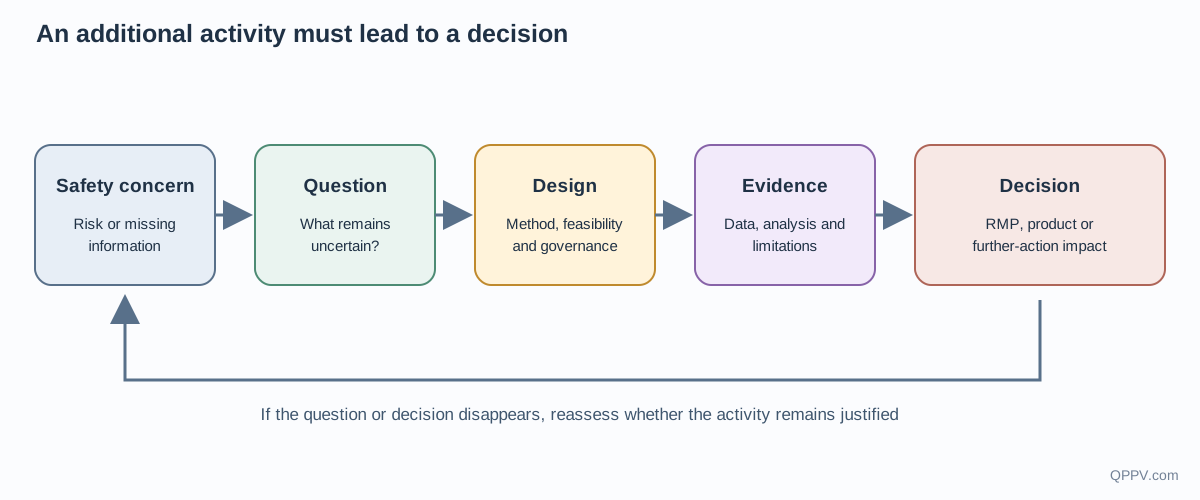
Figure 1. The activity should preserve traceability from the safety concern to the decision informed by its results.
Special situations and lifecycle management
Rare events and limited populations
For rare events, a study may provide only imprecise estimates. The absence of observed cases does not prove absence of risk when exposure or follow-up is limited. The report should state the observation window, denominator, completeness and remaining uncertainty.
Pregnancy and breastfeeding
Pregnancy and breastfeeding questions may require specialised registries, targeted follow-up or other designs. The activity should define exposure timing, maternal and infant outcomes, follow-up, loss to follow-up and the process for urgent safety information. The design should be consistent with current product- or population-specific guidance and data-protection requirements.
Biological and advanced therapies
For biological products and advanced therapies, traceability, product identity, batch or lot information, treatment setting and immunogenicity or procedure-related information may be important. An activity should specify which product and exposure characteristics are required and how information from different products will be distinguished.
Multiple products and active substances
A common activity may support more than one product or active substance, but the RMPs must explain the scope and limitations. Differences in indications, formulation, route, population, manufacturing or legal status may prevent direct pooling or require product-specific analyses.
Delays, infeasibility and protocol changes
When an activity is delayed or becomes infeasible, the MAH should assess the effect on the safety question and regulatory commitment. Possible responses include revised milestones, amended design, alternative data sources, interim risk-management measures, escalation or regulatory discussion. A protocol change should be documented with the reason, timing, effect on interpretation and RMP impact.
An activity should not continue by inertia. At defined review points ask whether the original question has been answered, whether remaining uncertainty is meaningful, whether new evidence has changed the rationale, whether the activity is producing useful information, whether the burden remains proportionate and whether the RMP or product information should change.
Inspection perspective and practical checklist
An inspector may ask:
- What uncertainty was the activity intended to resolve?
- Why was this design selected?
- What evidence supported feasibility?
- Was the activity conducted as approved?
- How were deviations, delays and amendments governed?
- Can the complete evidence chain be retrieved?
- How were vendors and partners overseen?
- How were emerging cases and signals handled during the activity?
- What decision followed the results?
- Was the RMP updated, or was a reasoned decision documented?
Potential failure modes below are illustrative:
- an RMP lists a study without a precise question;
- the protocol cannot be reconciled with the RMP;
- milestones are tracked but overdue risks are not escalated;
- vendor reports are accepted without quality review;
- data limitations are hidden in the conclusion;
- results are filed but not considered in benefit-risk evaluation;
- an activity continues after its question has ceased to be relevant;
- study-generated safety information is not integrated into routine PV.
Before approving or maintaining an additional activity, confirm that:
- the safety concern and missing-information issue are defined;
- the question and intended decision are explicit;
- routine PV limitations are explained;
- the design is proportionate and feasible;
- imposed and non-imposed status is clear;
- regulatory, ethics, data-protection and registration requirements are assessed;
- roles, vendors and escalation routes are defined;
- milestones and decision points are controlled;
- deviations and amendments are documented;
- study-generated safety information enters the PV system;
- results are interpreted with limitations and uncertainty;
- RMP and regulatory consequences are considered;
- records are retrievable for inspection.
Key takeaways
Additional pharmacovigilance activities are targeted components of a risk-management system. Their value lies in answering a defined question and improving a safety decision. A well-designed activity is proportionate, feasible, governed, traceable and connected to a documented action or conclusion.
References
- EMA, Good Pharmacovigilance Practices: Module V — Risk Management Systems.
- EMA, Good Pharmacovigilance Practices: Module VIII — Post-authorisation Safety Studies.
- EMA, Guidance on the format of the Risk Management Plan in the EU.
- European Commission, Commission Implementing Regulation (EU) No 520/2012.
- EMA, EU PAS Register.
- EMA, Good Pharmacovigilance Practices.
Regulatory Note
This article describes the EU pharmacovigilance framework at a general level. Whether an activity is required, imposed, submitted, registered or subject to a particular national procedure depends on the product, authorisation route, safety concern, study design and current applicable requirements. GVP guidance should be distinguished from binding legislation and from company operating practice.