Additional Risk Minimisation Measures in the EU
- Additional Risk Minimisation Measures in the EU
- Introduction
- Routine and additional risk minimisation
- Regulatory framework and RMP relationship
- Summary
- Selecting and designing the measure
- Implementation and effectiveness evaluation
- Summary
- Governance, special situations and inspection perspective
- Practical checklist
- Key takeaways
- References
- Regulatory Note
Introduction
Risk minimisation translates knowledge of a safety concern into measures intended to prevent an adverse reaction, reduce its likelihood, or reduce its severity and consequences. Routine measures, particularly the product information and conditions of use, address most safety concerns. Additional risk minimisation measures are used selectively when routine measures are not sufficient for an important risk or another defined safety concern.
An additional measure is not simply an extra communication activity. It is an intervention with an objective, a target population, an expected behaviour or system change, an implementation method and an approach to evaluating whether it works. The measure should be proportionate to the concern and feasible in the healthcare settings in which the medicine is used.
EU requirements and guidance are distributed across the risk-management framework. GVP Module V explains the place of risk minimisation in the Risk Management Plan (RMP). GVP Module XVI Rev. 3 addresses selection of tools and effectiveness indicators. Module XVI Addendum I addresses risk minimisation for medicinal products with embryo-fetal risks, and Addendum II addresses methods for evaluating effectiveness. National competent authorities have important roles in implementation and agreement of materials, especially for measures delivered through national healthcare systems.
Routine and additional risk minimisation
What routine measures do
Routine risk minimisation measures apply to medicinal products generally and include the SmPC, package leaflet, labelling, pack size and legal status of supply. The formulation, strength, route, device and other product characteristics may also reduce risk. Routine measures communicate the conditions for safe and effective use and provide information needed by healthcare professionals and patients.
Routine measures should not be treated as inadequate merely because an adverse reaction remains possible. Risk minimisation does not usually eliminate all risk. The relevant question is whether the routine measure is capable of achieving the required objective in the target population and setting.
When an additional measure may be needed
An additional measure may be considered when routine measures are insufficient to manage an important identified risk, important potential risk or defined missing-information concern. The rationale should explain:
- the safety concern and harm to be prevented or reduced;
- why the current routine measure is insufficient;
- the objective of the intervention;
- the population and setting;
- the mechanism by which the intervention should reduce risk;
- how implementation will be monitored;
- how effectiveness will be evaluated;
- what burden, unintended effects and residual risks may arise.
The decision is not purely technical. It should consider clinical practice, health-system variation, feasibility, patient burden, equity, data protection and the possibility that a complex programme may create new opportunities for failure.
The risk-minimisation logic chain
A useful logic model is:
Safety concern → risk-minimisation objective → measure → expected behaviour or system change → clinical outcome
For example, if a medicine can cause serious fetal harm, the objective may be to prevent exposure during pregnancy. A programme may combine prescriber information, patient counselling, pregnancy testing and controlled dispensing. The expected changes are that prescribers identify eligible patients, patients understand precautions and dispensing occurs only when defined conditions are met. The outcome measure may concern pregnancy exposure or fetal outcomes, but the choice and interpretation of outcome measures require an appropriate design.
The logic model should identify assumptions and failure points. Receipt of a leaflet does not prove that it was understood; understanding does not prove that behaviour changed; and behaviour change does not automatically prove that the clinical risk declined.
Figure: risk-minimisation logic chain
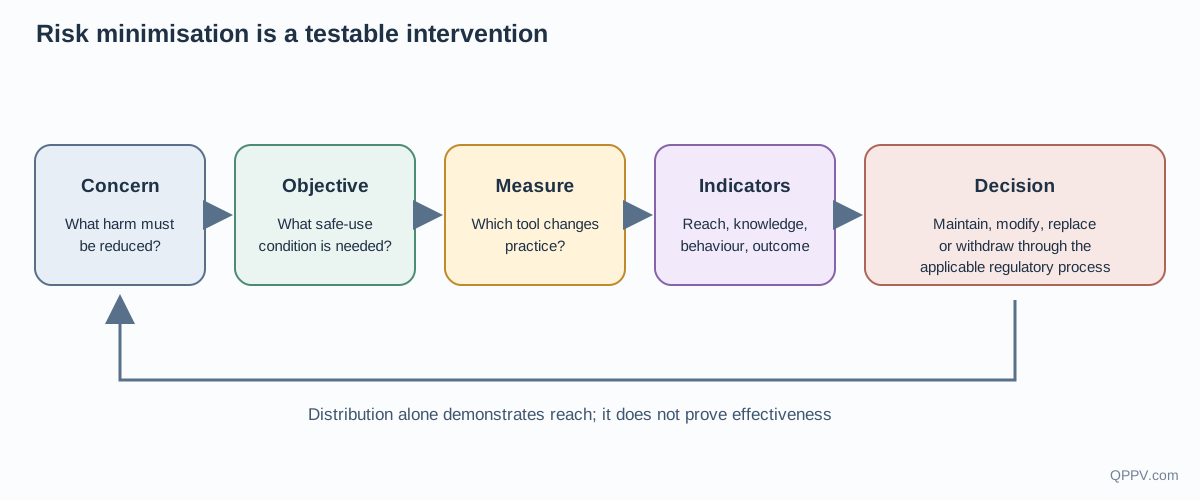
Figure 1. The logic chain separates the safety concern, intervention and evidence needed to determine whether the intended change occurred.
Regulatory framework and RMP relationship
GVP Module V requires the RMP to describe routine and additional risk minimisation activities for relevant safety concerns, including the objective and justification for additional measures and how effectiveness will be measured. GVP Module XVI provides detailed guidance on selection, tools and indicators. Module XVI Rev. 3 has a legal effective date of 6 August 2024. Addendum II on effectiveness evaluation has the same legal effective date. Addendum I on embryo-fetal risks has a legal effective date of 29 August 2025.
The RMP should identify the safety concern, objective, measure, target audience, implementation context and evaluation approach. It should not be confused with the implementation plan, educational material, distribution log or effectiveness-study protocol. Those operational documents elaborate the RMP and must remain consistent with it.
For centrally authorised medicines, EU-level requirements and national implementation interact. For nationally authorised products, national competent authorities may need to agree the content and implementation of measures in the relevant setting. The MAH must understand the authorisation route, regulatory decision, Member State requirements and agreed materials before implementation.
Summary
Additional risk minimisation is a targeted intervention, not an extra document attached to an RMP. Its defensibility depends on a continuous chain from safety concern to objective, tool, implementation, expected change, evaluation and decision.
Selecting and designing the measure
Educational materials
Educational materials may support safe use by communicating specific information to healthcare professionals or patients beyond routine product information. A suitable programme should identify the safety concern, required knowledge, target audience, key messages, expected action and method for assessing whether the audience received and understood the material.
The material should be consistent with approved product information and agreed regulatory content. Version control, translation, accessibility, distribution, acknowledgement and withdrawal of superseded versions require control. Educational material is not effective merely because it was printed or placed on a website.
Pregnancy prevention and embryo-fetal risk
Embryo-fetal risk may require a combination of routine and additional measures. Current GVP Module XVI Addendum I should be consulted for the applicable framework. A pregnancy prevention programme should be designed around the specific product risk, exposure pathways, treatment population, prescriber and dispensing context, pregnancy-testing requirements and follow-up of exposures.
A programme should not be described as universally mandatory in every case. Its content, scope and legal status depend on the regulatory decision and product. Measures may include counselling, contraception information, testing, treatment conditions, controlled supply or pregnancy-exposure follow-up, but the combination must be justified and feasible.
Controlled access and distribution systems
Controlled access or distribution can be appropriate where safe use depends on a condition that routine information cannot reliably achieve. The system should define eligibility, authorisation, verification, dispensing or supply controls, exceptions, data flows, privacy safeguards, monitoring and escalation.
A complex access system can fail through incorrect enrolment, delayed updates, emergency supply, poor interoperability, unclear responsibilities or unavailable support. The system should therefore be tested in realistic scenarios, including treatment changes, transfer between sites, loss of eligibility and system downtime.
Patient alert cards and communication tools
Patient alert cards, healthcare-professional communications and other tools may support recognition of a risk or communication between care providers. Their function should be defined precisely. A card that identifies treatment is not the same as a card that explains emergency action, and neither substitutes for clinical assessment.
The final content and format may require agreement with the competent authority. The organisation should control versions, language, distribution and withdrawal, and evaluate whether the target audience receives and uses the tool as intended.
Implementation and effectiveness evaluation
Implementation is part of the measure
A measure exists in practice only when the intended audience can access and use it in the relevant setting. Implementation planning should address:
- responsible MAH and local roles;
- competent-authority agreement;
- healthcare-system and Member State differences;
- final content and translations;
- distribution channels;
- training and support;
- digital-platform availability;
- vendor and subcontractor controls;
- data protection;
- version control and withdrawal;
- deviation and escalation handling;
- monitoring and reporting.
The MAH remains responsible for ensuring that agreed conditions and restrictions are implemented. Delegating distribution, training, platform management or data collection does not remove the need for oversight.
Indicators and levels of effectiveness
Effectiveness evaluation should match the logic model:
| Level | What it asks | Example |
|---|---|---|
| Reach or implementation | Did the measure reach the target population? | Availability of current material to the intended audience |
| Knowledge | Did the audience understand the key message? | Correct response to a validated knowledge question |
| Behaviour or process | Did practice change as intended? | Prescribing, dispensing or monitoring consistent with the condition |
| Clinical or public-health outcome | Did the risk or consequence change? | Exposure, event rate or severity outcome where measurable |
These levels are complementary. High reach does not prove knowledge; high knowledge does not prove behaviour; and an unchanged clinical outcome may reflect limited exposure, confounding, insufficient duration or an ineffective measure.
There is no universal KPI threshold for every additional measure. Targets, sampling, timing and decision rules should be justified in relation to the safety concern, tool, population, healthcare system and available data. Thresholds should not be invented merely to make a programme appear measurable.
Evaluation design
The evaluation design may include surveys, interviews, database studies, drug-utilisation studies, audits, registries, targeted follow-up or other methods. The design should specify population, sampling or data source, outcome definitions, timing, analysis, limitations, missing-data approach and decision rules.
The organisation should distinguish process evaluation from outcome evaluation. A distribution record may demonstrate delivery but not understanding. A knowledge survey may demonstrate understanding but not clinical behaviour. A utilisation study may demonstrate prescribing patterns but not the absence of adverse outcomes.
Results should be interpreted with other pharmacovigilance evidence. If the measure is ineffective, excessively burdensome or associated with unintended consequences, the MAH should consider modification, replacement, escalation, additional study or discontinuation through the applicable regulatory process.
Summary
The measure is part of a controlled intervention only when implementation, evaluation and governance are designed with the tool itself. The central question is not whether material was distributed, but whether the intended safe-use condition was achieved and what evidence supports that conclusion.
Governance, special situations and inspection perspective
Roles and evidence
The governance model should identify:
- safety-concern owner and risk-management lead;
- medical and regulatory decision-makers;
- local or national implementation owners;
- quality and compliance support;
- data and evaluation owners;
- vendors and subcontractors;
- escalation route to PV governance and the QPPV.
Inspection-ready evidence may include the RMP and regulatory decision, approved materials, authority correspondence, version and translation records, distribution evidence, training and acknowledgement records, platform logs, evaluation protocols and reports, deviation and CAPA records, vendor oversight and governance minutes.
The QPPV should have visibility of material implementation problems, effectiveness results, delays, significant deviations and decisions affecting the product’s risk-management system. The QPPV’s oversight role should not be confused with operational ownership of every distribution or training task.
Generic, hybrid and multiple-product situations
For generic products, additional measures may need to align with the reference product or active-substance approach where the concern and regulatory framework require it. Hybrid products may have different formulation, route, device, indication or use characteristics that justify product-specific measures. Similar active substances do not automatically mean identical implementation in every setting.
When a programme covers several products, the organisation should define which elements are common and which are product-specific. Shared materials can create consistency, but they can also obscure differences in dose, indication, population or safety concern.
Inspection perspective
Inspectors may ask:
- What evidence shows that routine measures were insufficient?
- What objective was the additional measure intended to achieve?
- Why was this tool selected?
- Which version was approved and distributed?
- How did the MAH know the target audience received and understood it?
- What evidence demonstrates the intended behaviour or process?
- How were Member State differences managed?
- How were vendors and digital platforms controlled?
- What happened when implementation failed?
- How did effectiveness results affect the RMP or product information?
Potential failure modes are illustrative:
- the measure is not linked to a specific safety concern;
- the material repeats routine information without a defined additional objective;
- distribution is documented but comprehension is not assessed;
- process indicators are presented as clinical effectiveness;
- materials remain available after supersession;
- local requirements or translations are not controlled;
- the evaluation is designed after results are known;
- an ineffective measure is continued without a decision;
- responsibilities are described but not evidenced.
Practical checklist
Before implementation or continuation, confirm that:
- the safety concern and risk-minimisation objective are explicit;
- routine measures and their limitations are described;
- the additional tool is proportionate and feasible;
- the RMP, regulatory decision and implementation plan agree;
- competent-authority and national requirements are addressed;
- materials are approved, version-controlled and accessible;
- target audiences and distribution channels are defined;
- vendors, platforms, data protection and business continuity are controlled;
- reach, knowledge, behaviour and outcome indicators are distinguished;
- evaluation methods and decision rules are pre-specified;
- deviations and CAPA are managed;
- results are considered in the RMP and benefit-risk assessment;
- QPPV and governance oversight is evidenced.
Key takeaways
Additional risk minimisation is a targeted intervention, not a decorative layer added to an RMP. Its scientific and regulatory defensibility depends on a continuous chain from safety concern to objective, tool, implementation, expected change, evaluation and decision. The measure should be understandable, feasible in practice and capable of being improved or withdrawn when the evidence warrants it.
References
- EMA, Good Pharmacovigilance Practices: Module V — Risk Management Systems.
- EMA, Good Pharmacovigilance Practices: Module XVI — Risk Minimisation Measures, Rev. 3.
- EMA, GVP Module XVI Addendum I — Risk minimisation measures for medicinal products with embryo-fetal risks.
- EMA, GVP Module XVI Addendum II — Methods for evaluating effectiveness of risk minimisation measures.
- EMA, Risk minimisation measures.
- European Commission, Commission Implementing Regulation (EU) No 520/2012.
Regulatory Note
This article provides general educational guidance. The legal status, content and implementation of an additional risk minimisation measure depend on the medicinal product, authorisation route, regulatory decision, safety concern, target population and applicable EU and national requirements. GVP guidance should be distinguished from binding legislation and from recommended operating practice.