Anselamimab: Amyloid-Fibril Targeting, Clinical Development and Pharmacovigilance in AL Amyloidosis
Anselamimab, previously CAEL-101, is an investigational chimeric monoclonal antibody developed to target deposited immunoglobulin light-chain amyloid. Its clinical rationale is complementary to treatment of the underlying plasma-cell disorder: suppressing further production of pathogenic light chains and removing existing deposits are different therapeutic tasks. The development programme also illustrates why a plausible mechanism, encouraging early organ responses and a favourable subgroup analysis do not by themselves establish efficacy in an entire intended population. [1–3]
This article treats anselamimab as investigational on the evidence reviewed through 17 October 2026. It does not supply an approved prescribing regimen or imply that orphan or expedited-development designations constitute marketing authorisation.
- Anselamimab: Amyloid-Fibril Targeting, Clinical Development and Pharmacovigilance in AL Amyloidosis
- Disease Biology and Therapeutic Purpose
- Antibody Classification and Mechanism
- Development and Ownership History
- Clinical Evidence from Early Studies to CARES
- Safety Assessment in a Fragile Population
- Practical Pharmacovigilance and Case Reconstruction
- Regulatory Framework and Safety Governance
- Remaining Evidence Questions
- Key Takeaways
- References
- Regulatory Note
Disease Biology and Therapeutic Purpose
In AL amyloidosis, abnormal immunoglobulin light chains produced by a plasma-cell clone misfold and accumulate in tissues. Organ dysfunction can persist after the clone has been suppressed. Consequently, a haematological response and an organ response answer different questions: the former concerns the source of the pathogenic protein, while the latter concerns the consequences of tissue injury and deposition. [1,2]
The distinction matters when evaluating an additional therapy. Improvement after treatment may reflect suppression of light-chain production, supportive care, an effect on deposits, or several processes together. Conversely, rapid haematological control may coexist with continuing cardiac deterioration. An assessment should preserve these separate trajectories rather than classify every change as a single overall “response”.
Anselamimab is intended to address the deposited material. It is not a replacement for anti-plasma-cell treatment and should not be described as directly eradicating the underlying clone. The clinically relevant question is whether adding a fibril-directed intervention improves outcomes beyond those achieved with the background regimen. That requires controlled clinical evidence, not only target binding.
Antibody Classification and Mechanism
CAEL-101 is the chimeric IgG1 form of the murine antibody 11-1F4. The early primary publication describes recognition of a conformational neoepitope on misfolded light chains and promotion of phagocytic clearance, with sparing of native soluble free light chains. Preclinical amyloidoma experiments and human imaging supported development of the approach. [1]
These observations establish the rationale for investigating fibril removal; they do not establish how completely deposits are removed in an individual patient or prove that a biomarker change measures removal. Target recognition, biological activity, organ function and survival are related but distinct levels of evidence.
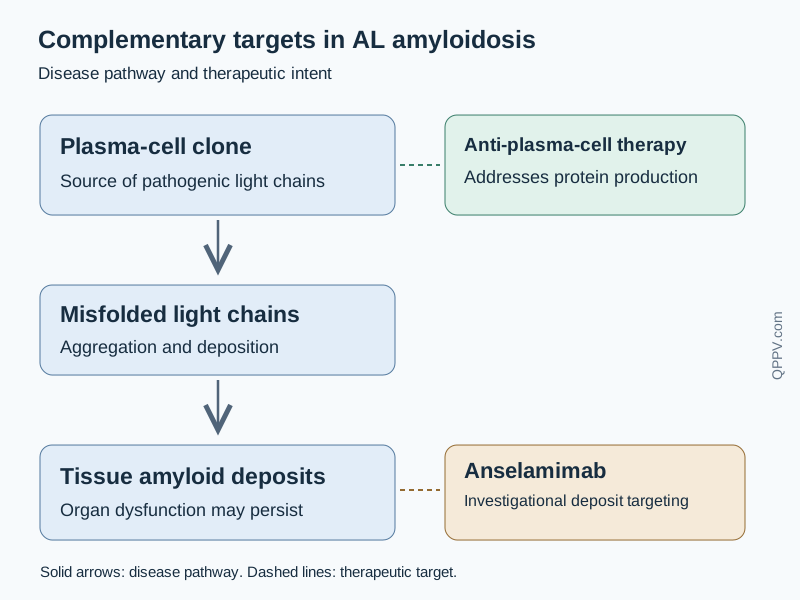
Figure 1. Anti-plasma-cell therapy addresses pathogenic light-chain production; anselamimab is investigated against deposited amyloid. The two targets are complementary. Arrows show disease progression, not a proven magnitude or speed of treatment benefit. Based on the mechanistic rationale in references 1 and 2.
Development and Ownership History
Early clinical development followed the 11-1F4 programme under the CAEL-101 designation. Its initial evidence was exploratory; the later controlled programme addressed a different evidential question. [1]
The commercial development history explains the later sponsor identity. Caelum and Alexion entered a collaboration in 2019 that included a minority interest and an acquisition option. AstraZeneca announced exercise of that option in September 2021, after its acquisition of Alexion. The acquisition of Caelum closed in October 2021, transferring the programme into the Alexion/AstraZeneca development organisation. These transactions describe stewardship of the asset, not a change in its pharmacological identity or evidence standard. [4,5]
The historical record also includes FDA Fast Track and US/EU orphan designations. These facilitate or recognise development in a rare disease; they do not certify clinical benefit, establish a labelled indication or create an approved risk-management regimen. The later CARES results must therefore be evaluated on their own terms rather than inferred from the designations. [4]
Clinical Evidence from Early Studies to CARES
The early phase 1a/b study reported no dose-limiting toxicity and no drug-related serious adverse events in the studied exposure range. Exploratory organ responses encouraged development. However, its small, uncontrolled design, prior treatment and selected organ-function eligibility limit causal interpretation and extrapolation to more fragile patients. The publication also states that anti-drug antibodies were not measured in that study. A favourable tolerability observation in this setting does not resolve uncommon toxicity or immunogenicity. [1]
The subsequent open-label phase 2 dose-selection study combined anselamimab with cyclophosphamide, bortezomib and dexamethasone, with a further cohort also receiving daratumumab. Among 25 participants, all experienced a treatment-emergent adverse event, 16 experienced a serious event and three experienced a fatal event. The abstract reports that serious and fatal events were adjudicated unrelated to study drug and that no dose-limiting toxicities occurred. These are study findings with their stated attribution; they should not be rewritten as proof that the antibody cannot contribute to serious events. [2]
The combination setting introduces an unavoidable attribution problem. An event may arise from the disease, an individual component, interacting treatments, an infection or supportive management. A single-arm study can describe what occurred and inform subsequent surveillance, but it cannot reliably isolate the incremental risk of the antibody.
Randomised Evidence and the Overall Result
CARES comprised parallel randomised, double-blind, placebo-controlled trials in newly diagnosed AL amyloidosis with advanced cardiac involvement, separated by European modification of Mayo 2004 stages IIIa and IIIb. Anselamimab was added to background anti-plasma-cell therapy. The programme’s overall primary endpoint combined all-cause mortality and cardiovascular hospitalisation hierarchically. The overall analysis did not meet its primary endpoint. [3,6]
A prespecified analysis in the kappa light-chain subgroup favoured anselamimab, and the sponsor characterised the subgroup statistical results as nominal. This is a potentially important observation, but it should remain explicitly subordinate to the overall result and the analysis plan. It does not justify describing the entire programme as a positive trial or extending a subgroup conclusion to lambda disease. [3,6]
| Evidence level | What it contributes | What it does not establish |
|---|---|---|
| Target-binding and preclinical work | Biological rationale for fibril targeting | Clinical benefit in advanced cardiac disease |
| Uncontrolled early studies | Feasibility, observed tolerability and exploratory responses | Incremental benefit or risk versus background therapy |
| Randomised overall CARES analysis | Comparative assessment in the studied population | A positive overall efficacy conclusion after a missed primary endpoint |
| Prespecified kappa subgroup | A defined signal of possible differential benefit | Automatic confirmation, regulatory approval or benefit in other isotypes |
The CARES primary paper has an associated erratum. Quantitative re-analysis should use the corrected publication and supplements together with the protocol and statistical analysis plan. This article deliberately avoids reproducing detailed subgroup effect sizes before that correction can be fully checked. The erratum’s existence is not evidence that the overall conclusion reversed. [7]
Interpreting Benefit and Harm Together
Subgroup evaluation should examine whether the biological explanation was specified before unblinding, how many comparisons were made, whether baseline prognostic factors were balanced, and whether results are consistent across relevant outcomes. A favourable point estimate alone does not answer those questions. A nominal probability value must not be presented as though multiplicity control has necessarily established a confirmatory claim.
Survival also affects safety observation. If one group remains alive and exposed longer, it has more opportunity to accumulate adverse events. Conversely, early deaths can reduce the time available to observe later toxicity. An adequate comparison therefore considers follow-up, exposure, competing events and reasons for discontinuation alongside crude event proportions. This is a methodological interpretation, not an allegation that a specific CARES analysis was defective.
Safety Assessment in a Fragile Population
Advanced AL amyloidosis can produce clinical deterioration that resembles treatment toxicity. An infusion-related episode, cardiac decompensation and autonomic hypotension may share features while requiring different clinical explanations. Case review should begin with the actual phenotype and chronology rather than the assumption that an event is either “the disease” or “the antibody”.
For acute symptoms, obtain infusion timing, rate, concomitant administrations, observations before and during treatment, interventions and response. For a hospitalisation, establish the admitting diagnosis, objective findings and subsequent clinical course. An administrative category such as cardiovascular hospitalisation is valuable for trial analysis, but it is insufficient as the clinical description in an individual safety narrative.
The distinction between treatment-emergent and treatment-related is essential. Treatment-emergent describes occurrence during a defined observation period; it does not establish causation. An investigator’s assessment of unrelatedness should be preserved together with its rationale, while the sponsor retains an independent responsibility to evaluate accumulating evidence under the applicable trial framework.
Immunogenicity is a surveillance question rather than a presumed clinical diagnosis. If anti-drug antibody testing is available, interpret the assay result with sampling time, exposure, clinical symptoms and assay limitations. A positive result is not automatically neutralising, and a negative result does not exclude every immune-mediated reaction. No product-specific rate or causal mechanism is asserted here beyond the evidence cited.
Practical Pharmacovigilance and Case Reconstruction
The following approach is recommended operational practice for investigational safety review. It is not an approved monitoring schedule. The protocol, investigator’s brochure and applicable regulatory requirements govern actual trial conduct.
A useful case record connects the patient’s starting condition, all relevant exposures, the event and its evolution. Baseline cardiac and renal status matter because “worsening” cannot be understood without a comparator. The record should also identify the light-chain isotype and haematological response, while avoiding the inference that membership in a favourable efficacy subgroup makes an adverse event less important.
| Clinical question | Information to seek | Interpretation supported |
|---|---|---|
| Did symptoms begin during or soon after infusion? | Start/stop times, rate, vital signs, symptoms, treatment and re-exposure | Characterisation of an acute administration-associated event |
| Was there cardiac deterioration? | Prior functional status, rhythm, congestion, imaging, biomarkers, renal function and fluid management | Distinguishing progression, intercurrent illness and possible treatment contribution |
| Could background therapy explain the event? | Dates and doses of each agent, cycles, interruptions and supportive medication | Assessment of competing or interacting exposures |
| Is an immune response suspected? | Clinical phenotype and available timed antibody samples | Evaluation of a hypothesis without equating assay positivity with clinical causation |
| Did the event resolve or recur? | Recovery, treatment changes, subsequent exposures and follow-up | Assessment of course while recognising confounding by simultaneous interventions |
A medically useful narrative should state what was reported separately from what was concluded. If fluid management changed at the same time as study-drug interruption, improvement cannot be attributed confidently to withdrawal alone. If a patient dies, obtain the best available cause-of-death evidence and circumstances; missing information should remain visible rather than being replaced by a convenient disease-progression label.
An illustrative scenario shows the reasoning. A participant develops hypotension during an infusion and is subsequently admitted with congestion. The reviewer should reconstruct whether hypotension preceded treatment, whether other medicines or an intercurrent illness contributed, how fluid was administered and what objective findings supported the admission diagnosis. More than one process may have occurred. This hypothetical example does not describe a published anselamimab case or a recognised labelled reaction.
Regulatory Framework and Safety Governance
An investigational antibody must be assessed within the clinical-trial safety framework. In EU trials, Regulation (EU) No 536/2014 distinguishes adverse-event collection, serious-adverse-event reporting and sponsor reporting of suspected unexpected serious adverse reactions. Seriousness, suspected relationship and unexpectedness are separate assessments; a serious event is not automatically a SUSAR. Protocol provisions and the authorised reference safety information must be checked when applying those rules. [8]
This differs from describing routine post-authorisation obligations for a marketed medicine. No approved anselamimab SmPC, US prescribing information, mandatory premedication schedule or authorised RMP is supplied by the sources reviewed here. Trial dosing is evidence about development, not a prescribing recommendation.
Operational governance should maintain one consistent view of the evolving evidence across the safety database, investigator’s brochure, aggregate safety reviews and study documents. A subgroup efficacy result should not silently change expectedness assessment or remove an adverse event from scrutiny. Similarly, a revised causal assessment should be traceable, including the new evidence and the date of the decision.
Relevant quality checks include reliable transfer of serious-event information, reconciliation of deaths and hospitalisations across clinical and safety datasets, access to adjudication records, and preservation of the versions used for assessment. These are practical control suggestions. They are not presented as a list of findings from an inspection of this programme.
Remaining Evidence Questions
The next development question is whether the kappa subgroup observation can support a sufficiently robust benefit-risk conclusion in a clearly defined population. That requires the full corrected evidence, regulatory assessment and, where needed, further investigation. The available result should neither be dismissed because the overall endpoint failed nor promoted into an established treatment benefit beyond its evidential scope.
For safety surveillance, priorities include characterising acute administration events, interpreting deterioration against the background of cardiac disease, understanding immunogenicity where adequately measured, and evaluating longer exposure alongside evolving background treatment. These are prospective questions, not a declaration of identified product risks.
Comparison across studies must retain the original population. An early study with restrictions on severe organ dysfunction and a later trial enrolling advanced cardiac disease do not provide interchangeable estimates of tolerability. Likewise, adverse-event frequencies from a combination regimen should not be transplanted into an imagined monotherapy label.
Key Takeaways
Anselamimab investigates a distinct therapeutic target: existing light-chain amyloid deposits rather than the plasma-cell source. Its development connects a fibril-reactive antibody lineage, early organ-response observations and a controlled programme in advanced cardiac AL amyloidosis.
The overall CARES primary endpoint was not met. The kappa subgroup observation warrants careful evaluation with the corrected publication and analysis plan; it is not interchangeable with a successful overall trial or marketing authorisation. Safety interpretation requires equal care: an event can be common in the disease and still deserve rigorous treatment-relatedness assessment.
For pharmacovigilance professionals, the central discipline is to preserve the chain from baseline disease and exposure through event characterisation, competing explanations, adjudication and follow-up. That makes uncertainty reviewable rather than disguising it as certainty.
References
- Edwards CV, et al. Phase 1a/b study of monoclonal antibody CAEL-101 (11-1F4) in patients with AL amyloidosis. Blood. 2021;138:2632–2641. doi:10.1182/blood.2020009039. Author-institution-hosted full text.
- Valent J, et al. Safety and tolerability of anselamimab in participants with light chain amyloidosis: Results from a phase 2 study. European Journal of Cancer. 2026;248:117039. doi:10.1016/j.ejca.2026.117039. Institution-hosted abstract.
- Wechalekar AD, et al. Efficacy and Safety of Anselamimab in Immunoglobulin Light Chain Amyloidosis: Results From the Randomized CARES Trials. Journal of Clinical Oncology. 2026. doi:10.1200/JCO-26-00755. Read with reference 7.
- AstraZeneca. AstraZeneca to fully acquire Caelum Biosciences. 29 September 2021. Development and acquisition announcement. Corporate primary source for ownership and designations.
- Fortress Biotech. Closing of acquisition of Caelum Biosciences by AstraZeneca. 6 October 2021. Transaction completion announcement.
- AstraZeneca. CARES Phase III clinical programme did not meet primary endpoint in overall light chain amyloidosis population. 29 May 2026. Sponsor results disclosure. Sponsor interpretation is distinguished from regulatory assessment.
- Erratum: Efficacy and Safety of Anselamimab in Immunoglobulin Light Chain Amyloidosis: Results From the Randomized CARES Trials. Journal of Clinical Oncology. 2026. doi:10.1200/JCO-26-01665. The correction notice was identified, but its full text could not be retrieved during this review; detailed corrected efficacy estimates are therefore not reproduced.
- European Union. Regulation (EU) No 536/2014 on clinical trials on medicinal products for human use, particularly Articles 41–43. EUR-Lex.
Regulatory Note
Sources were reviewed through 17 October 2026. Anselamimab is discussed as an investigational product on the evidence reviewed, not as an authorised treatment. No prescribing instructions are inferred from research dosing. Mechanistic rationale, trial results, sponsor interpretation and recommended safety-review practice are distinguished throughout. The inability to retrieve the full CARES erratum limits detailed quantitative interpretation. This article is a professional educational reference; actual trial safety reporting must follow applicable law, approved trial documents and current regulatory advice.