The IME List in Pharmacovigilance: Important Medical Events, Seriousness and Practical Use
The Important Medical Events (IME) list is one of the most widely used reference tools in routine pharmacovigilance case processing. It is also easy to misunderstand.
The list is a MedDRA-based set of Preferred Terms maintained in the EudraVigilance framework to help pharmacovigilance professionals identify events that may warrant consideration as medically important. Its purpose is practical: to support classification of suspected adverse reactions, individual case assessment and analysis of aggregated safety data.
It is not a separate legal definition of seriousness, and appearance of a MedDRA term on the IME list does not remove the need to understand what actually happened to the patient. The governing concept comes from ICH E2A and EU GVP: an event may be serious because it resulted in death, was life-threatening, required or prolonged inpatient hospitalisation, caused persistent or significant disability/incapacity, caused a congenital anomaly/birth defect, or because medical and scientific judgement indicates that it was an important medical event that jeopardised the patient or required intervention to prevent one of those outcomes.
That distinction explains both the usefulness and the limits of the IME list.
- The IME List in Pharmacovigilance: Important Medical Events, Seriousness and Practical Use
- Purpose and Scope
- Seriousness Comes Before the IME List
- What the IME List Is
- Why EMA Uses Inclusion and Exclusion Criteria
- IME Does Not Mean the Same Thing as Serious
- Seriousness Is Not Severity
- Applying the IME List to an Individual ICSR
- Multiple Reactions in the Same Case
- Follow-Up of Potentially Important Medical Events
- Use in Aggregate Analysis and Signal Detection
- IME Status Does Not Establish Causality
- IME Status Does Not Establish Expectedness
- IME List Versus Designated Medical Events
- Version Control Matters
- Automation: Useful Guardrail, Poor Substitute for Judgement
- Coding Changes Can Change the Flag
- Quality Management and Governance
- Common Failure Modes
- Inspection Considerations
- Practical Decision Framework
- Key Takeaways
- References
- Regulatory Note
Purpose and Scope
This article explains the current EMA IME list and its use in post-authorisation pharmacovigilance. It focuses on what the list represents, how it relates to formal seriousness criteria, how it should be applied to individual ICSRs, how it can support aggregate analysis and signal work, and how a pharmacovigilance system should govern list versions, automation and medical review.
The current EMA publication at the time of review is MedDRA Important Medical Event Terms list version 29.1, reference EMA/211097/2026, updated on 18 September 2026. EMA maintains the list twice each year in line with MedDRA releases, publishing X.0 by 31 March and X.1 by 30 September.
The IME list should therefore be understood as a maintained pharmacovigilance reference artefact rather than a static catalogue.
Seriousness Comes Before the IME List
To understand the list, it is necessary first to understand the regulatory concept it supports.
ICH E2A defines a serious adverse event or adverse reaction by outcome. An event is serious when it results in death, is life-threatening, requires inpatient hospitalisation or prolongation of existing hospitalisation, results in persistent or significant disability or incapacity, or is a congenital anomaly or birth defect.
ICH E2A then addresses situations that do not necessarily produce one of those outcomes but may nevertheless be medically serious. Medical and scientific judgement should be exercised for important medical events that may jeopardise the patient or may require intervention to prevent one of the listed serious outcomes.
EU GVP Module VI carries this principle into post-authorisation case management. It states that some medical events may jeopardise the patient or require intervention to prevent a serious consequence and that such important medical events should be considered serious.
The resulting model is:
reported clinical event → actual consequences and circumstances → formal seriousness criteria → medical judgement where required → seriousness classification
The IME list supports the judgement step. It does not replace the model.
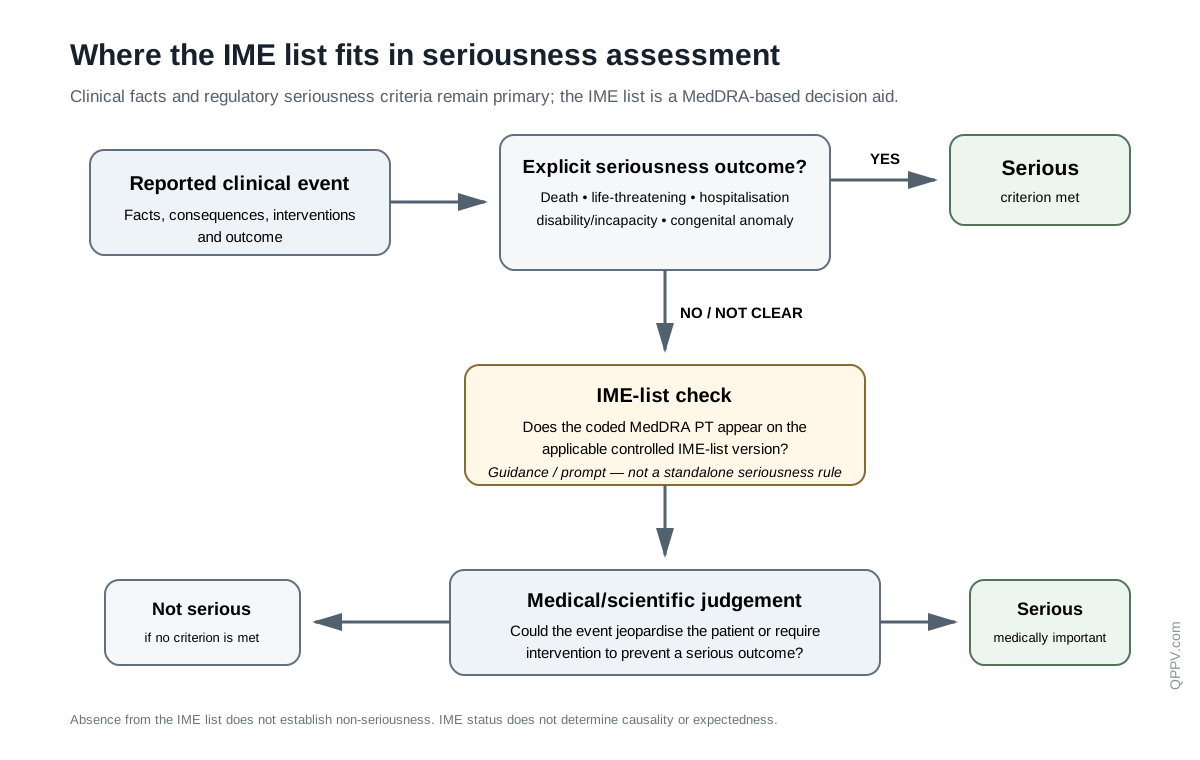
Figure 1. The IME list acts as a MedDRA-based decision aid within seriousness assessment. It does not supersede outcome-based seriousness criteria or case-specific medical judgement.
What the IME List Is
The EudraVigilance Expert Working Group coordinated development of the IME list. EMA describes its aims as facilitating classification of suspected adverse reactions, analysis of aggregated data, and assessment of ICSRs in day-to-day pharmacovigilance.
The list is built from MedDRA Preferred Terms (PTs). This matters operationally because the list can be matched against coded reaction terms in a safety database, used in searches and reports, and updated when MedDRA changes.
EMA expressly states that the list is for guidance purposes only.
That qualification is central to correct use. The list is a structured aid for recognising events that commonly have the characteristics of important medical events. It is not a rule that converts every report coded to a listed PT into an automatically serious case without regard to the reported clinical facts.
Why EMA Uses Inclusion and Exclusion Criteria
A useful IME list cannot simply contain every diagnosis that might occasionally become serious. It needs a reproducible medical rationale.
EMA therefore maintains published inclusion/exclusion criteria for the list. These criteria are grounded in the ICH definitions of seriousness and important medical events and are reviewed in the context of MedDRA maintenance.
The criteria help answer a different question from case processing:
At the terminology level, is this medical concept sufficiently associated with potentially serious clinical consequences that it should be available as an IME flag?
Case processing asks:
In this patient, given the reported facts and consequences, should this reaction be classified as serious?
Confusing those two questions is the main conceptual error in IME-list use.
The list necessarily operates at the level of a coded medical concept. The ICSR contains the clinical reality: severity, timing, treatment, complications, interventions, hospitalisation, outcome, comorbidities and reporter assessment. Seriousness is ultimately assessed from that reality.
IME Does Not Mean the Same Thing as Serious
An event can be serious without appearing on the IME list, and an IME-list match should not be treated as the only route to seriousness.
Consider a patient who develops severe vomiting, is admitted to hospital and requires intravenous fluid replacement. The decisive seriousness information is the hospitalisation, irrespective of whether the selected MedDRA PT is an IME.
Conversely, a term may be included on the IME list because the medical concept can jeopardise a patient or commonly warrants urgent intervention. A particular report may be sparse, ambiguous, miscoded or describe circumstances that require clarification. The IME flag should prompt appropriate assessment rather than substitute for it.
| MedDRA term on IME list? | Other seriousness evidence? | Appropriate interpretation |
|---|---|---|
| Yes | Yes | Seriousness is supported by the reported outcome/circumstances; IME status may provide additional context |
| Yes | Not clearly documented | Review the clinical facts and apply medical judgement; do not use the flag as a substitute for assessment |
| No | Yes | The event may still be serious because seriousness is not limited to IME-listed terms |
| No | No | Assess normally; absence from the list does not prove non-seriousness |
The list is therefore asymmetric as a screening tool. A positive match can draw attention to a potentially important event. A negative match cannot safely be interpreted as “non-serious”.
Seriousness Is Not Severity
IME assessment also depends on keeping seriousness separate from severity.
Severity describes intensity: for example, mild, moderate or severe. Seriousness is a regulatory classification based on outcomes and medically important circumstances.
A severe headache can be non-serious. A clinically modest event can be serious if, for example, it leads to inpatient hospitalisation or represents a medically important condition requiring intervention to prevent a serious outcome.
The word “important” in Important Medical Event should not be read as a synonym for “severe”. It belongs to the regulatory seriousness framework.
Applying the IME List to an Individual ICSR
A robust case-processing workflow starts with the source information, not the spreadsheet.
Establish what was reported
The processor should determine the event as described by the reporter and preserve relevant source wording. Diagnosis, signs and symptoms, investigations, treatment, hospitalisation, outcome and relevant medical history may all influence the assessment.
Code the event appropriately in MedDRA
The reported information should be coded according to applicable MedDRA coding conventions and company procedures. Coding should reflect the reported medical concept; it should not be manipulated merely to obtain or avoid an IME match.
Assess explicit seriousness criteria
Before considering “other medically important”, determine whether the event already meets an outcome-based seriousness criterion such as death, life-threatening status, hospitalisation, disability/incapacity or congenital anomaly/birth defect.
Where one of these is met, seriousness does not depend on IME-list membership.
Identify an IME-list match
A safety system may compare the coded PT with the applicable IME-list version. The match is useful as a prompt for the processor or medical reviewer.
The system should retain enough configuration information to establish which IME version was applied.
Apply medical judgement
Where the event does not otherwise meet a seriousness criterion, assess whether it may jeopardise the patient or require intervention to prevent a serious outcome.
Relevant information can include the nature of the diagnosis, the patient's clinical state, treatment or intervention required, potential for deterioration, relevant laboratory or diagnostic findings, complications and the clinical context in which the event occurred.
The purpose is not to ask whether the PT is “important in general”. It is to determine whether the reported occurrence meets the medically important seriousness concept.
Document the conclusion
Where a seriousness decision requires judgement, the case should contain sufficient information to reconstruct the basis for the decision according to the organisation's procedures.
A reviewer should be able to understand why the event was classified as serious or non-serious and what evidence was available at that time.
Multiple Reactions in the Same Case
An ICSR may contain several reactions with different seriousness characteristics. Under E2B(R3), seriousness information can be represented at reaction level. Operationally, this makes it important not to let one IME-listed reaction obscure the assessment of the others.
For example, a case may contain a reaction associated with hospitalisation, another IME-list PT requiring medical judgement, and a third non-serious symptom. Each reaction should be understood on its own facts even though the presence of a serious reaction affects overall case handling.
The IME list is therefore most useful when integrated into reaction-level review rather than treated as a crude case-level label.
Follow-Up of Potentially Important Medical Events
An IME flag can also help prioritise follow-up.
Where the initial report lacks enough clinical detail to understand the seriousness, targeted follow-up may seek confirmation of diagnosis, clinical course and outcome, relevant investigations, treatment, hospitalisation, and whether an intervention prevented a more serious consequence.
Follow-up should be proportionate and medically purposeful. The presence of an IME flag does not justify collecting irrelevant information, but it can help identify which missing facts are important to case assessment.
Use in Aggregate Analysis and Signal Detection
EMA's stated purpose for the IME list extends beyond individual seriousness classification to aggregated data analysis.
That use is important because medically consequential events may deserve focused review even when the overall number of reports is small. An IME flag can be incorporated into line listings, case-series searches, signal-detection outputs, product-event review, disproportionality-result triage, aggregate report preparation and medical review dashboards.
The list should be treated as one dimension of prioritisation. It does not establish causality, expectedness, frequency or signal validity.
A cluster of IME-listed PTs associated with a medicinal product can be a reason to examine the cases more closely. It is not, by itself, evidence that the product caused the events.
IME Status Does Not Establish Causality
Seriousness and causality answer different questions.
Seriousness asks about the medical outcome or importance of the event.
Causality asks whether there is a reasonable possibility that the medicinal product caused or contributed to the event, using the applicable case and regulatory framework.
An event can therefore be serious and related, serious without an established causal relationship, non-serious and related, or insufficiently documented for a confident causal assessment.
IME-list membership does not resolve causality. This distinction becomes especially important in aggregate review, where a visually prominent IME flag can create an unintended cognitive bias toward assuming a causal relationship.
IME Status Does Not Establish Expectedness
Expectedness is also separate.
For reporting frameworks in which expectedness matters, expectedness is assessed against the applicable reference safety information under the governing rules. An IME-list match is not a substitute for that comparison.
A reaction may be an IME and expected, an IME and unexpected, non-IME and expected, or non-IME and unexpected.
The concepts should remain separate in both database design and reviewer training.
IME List Versus Designated Medical Events
Important Medical Events should not be confused with Designated Medical Events (DMEs) used in signal-detection contexts.
The IME list is a broad MedDRA-based aid to seriousness classification, case assessment and aggregate analysis. A DME concept is used more selectively in signal detection to identify particular medically important conditions for focused surveillance.
The purpose and scope are therefore different. A pharmacovigilance procedure should use the terms precisely rather than calling every IME a designated medical event.
Version Control Matters
The IME list changes with MedDRA.
EMA currently maintains the list twice yearly: version X.0 by 31 March and version X.1 by 30 September. The current version at this article's review date is 29.1.
A controlled pharmacovigilance environment should therefore know which MedDRA version the safety system uses, which corresponding IME list is active, when the new list becomes effective internally, whether validation or regression testing is required for automated flags, how historical cases are handled after an update, and how the applied version can be reconstructed.
An IME update should not be treated as an uncontrolled spreadsheet replacement.
Changes can affect automated seriousness prompts, searches, dashboards, listings and downstream analytics. The impact assessment should match the way the organisation actually uses the list.
Automation: Useful Guardrail, Poor Substitute for Judgement
The IME list is well suited to automation because it consists of MedDRA terms. A safety system can flag a reaction when its PT appears in the configured list.
That is useful for preventing oversight. It becomes problematic when the software is designed so that the flag is treated as an unquestionable clinical conclusion.
A sensible control design can identify the IME match, alert the processor or reviewer, require assessment of applicable seriousness criteria, allow authorised medical judgement where appropriate, capture the rationale required by procedure and preserve an audit trail.
The purpose of automation is to make the relevant medical question difficult to miss, not to remove the question.
Coding Changes Can Change the Flag
Because IME status is linked to the coded MedDRA PT, changes in coding can change whether the event matches the list.
That creates an important quality-control relationship:
source information → MedDRA coding → PT → IME match → review
If coding is inaccurate, the IME flag may also be inaccurate.
For this reason, disagreement about IME status should sometimes trigger a coding review rather than an argument about seriousness. The first question may be whether the chosen PT accurately represents the source information.
The reverse is equally important: coding should never be altered merely to force the desired seriousness outcome. Clinical classification follows the evidence; terminology supports its structured representation.
Quality Management and Governance
The IME list touches several parts of the pharmacovigilance system: case processing, medical review, MedDRA maintenance, safety-database configuration, aggregate analysis and signal management.
Governance should therefore define both ownership and interfaces.
| Control | Evidence that should be reconstructable |
|---|---|
| Current reference | Approved IME and MedDRA versions |
| Implementation | Date/version deployed and relevant change control |
| Case processing | How IME matches are presented and assessed |
| Medical review | Escalation and judgement rules where needed |
| Coding | Applicable MedDRA coding conventions and QC |
| Aggregate use | How IME flags affect searches or prioritisation |
| Validation | Testing of automated matching where applicable |
| Training | Evidence that users understand IME versus seriousness |
| Oversight | Deviations, trends, CAPA and effectiveness checks where relevant |
The exact controls are organisational choices unless a specific regulatory requirement dictates otherwise. The objective is to make the process reliable, traceable and medically defensible.
Common Failure Modes
Several recurrent design errors can undermine IME use.
Treating every IME match as a complete seriousness assessment. This replaces medical assessment with terminology lookup. The list was created to facilitate assessment and is explicitly guidance.
Treating every non-IME term as non-serious. This can miss events that meet an explicit seriousness outcome or are medically important in their particular clinical context.
Confusing seriousness with severity. A “severe” event is not automatically serious, and an event need not be described as severe to meet a seriousness criterion.
Using an outdated list. A system that updates MedDRA but leaves the associated IME configuration behind can produce inconsistent flags.
Allowing coding to drive the desired outcome. MedDRA coding should represent the source information. It should not be selected to manufacture a seriousness classification.
Losing the rationale for medical judgement. Where the facts are not self-explanatory, an undocumented override or classification can make later QC, aggregate review and inspection reconstruction difficult.
Treating IME status as evidence of causality or a signal. The list identifies medically important concepts. It does not establish a product-event causal relationship.
Inspection Considerations
An inspector assessing this area would be interested less in whether an organisation has downloaded the spreadsheet than in whether the overall process works.
Illustrative inspection questions include:
- Which IME and MedDRA versions are currently implemented?
- How does the organisation identify and assess an IME match?
- Can the system recognise serious events that are not on the IME list?
- How are medically important seriousness decisions documented?
- Who can change or override automated classifications?
- How are list updates controlled and tested?
- How does the IME configuration interact with aggregate analysis and signal detection?
- Can a historical case be reconstructed using the terminology and rules applicable when it was processed?
These are illustrative questions, not reported inspection findings.
Evidence of effectiveness could include correctly processed sample cases, controlled configuration records, audit trails, training, QC results, deviations and documented remediation where errors have occurred.
Practical Decision Framework
For each reported reaction, a processor or medical reviewer can work through the following sequence:
- What happened? Establish the clinical event from the source.
- How should it be coded? Select the appropriate MedDRA representation.
- Did it meet an explicit seriousness outcome? Check death, life-threatening status, hospitalisation, disability/incapacity and congenital anomaly/birth defect.
- Is the PT on the applicable IME list? Use the current controlled version as a prompt.
- If an explicit outcome is absent, is the event nevertheless medically important? Apply medical/scientific judgement to whether it jeopardised the patient or required intervention to prevent a serious outcome.
- Is follow-up needed? Seek information that could materially clarify the assessment.
- Is the conclusion documented and traceable? Preserve the basis for the classification.
- Are causality and expectedness being assessed separately? Do not allow the IME flag to answer different regulatory questions.
This sequence preserves the proper hierarchy: clinical facts first, regulatory criteria second, terminology aid third.
Key Takeaways
The EMA IME list is a MedDRA-based pharmacovigilance tool designed to facilitate classification of suspected adverse reactions, ICSR assessment and aggregate analysis.
Its correct use depends on several distinctions: the IME list supports the seriousness framework but does not replace it; EMA explicitly describes the list as guidance; seriousness is not the same as severity; IME status does not determine causality or expectedness; absence from the IME list does not establish that an event is non-serious; and list/version governance matters because EMA updates the IME list with MedDRA twice yearly.
The most defensible operational principle is simple: use the IME list to make important medical questions visible, while retaining the clinical judgement that the regulatory framework requires.
References
- European Medicines Agency. EudraVigilance system overview — Important medical event list. Current page accessed 8 October 2026. Identifies MedDRA IME list version 29.1 (EMA/211097/2026), updated 18 September 2026, and the twice-yearly maintenance schedule.
- European Medicines Agency. MedDRA important medical event terms list (IME) — version 29.1. EMA/211097/2026. Updated 18 September 2026.
- European Medicines Agency. Inclusion/exclusion criteria for the “Important Medical Events” list. EMA/126913/2021 Rev., 22 September 2025.
- European Medicines Agency. Guideline on good pharmacovigilance practices (GVP) Module VI — Collection, management and submission of reports of suspected adverse reactions to medicinal products. Revision 2. EMA/873138/2011 Rev. 2.
- International Council for Harmonisation. ICH E2A: Clinical Safety Data Management: Definitions and Standards for Expedited Reporting. 1994.
- International Council for Harmonisation. ICH E2B(R3): Electronic Transmission of Individual Case Safety Reports — Implementation Guide, current applicable materials.
- Medical Dictionary for Regulatory Activities. MedDRA Introductory Guide and terminology documentation, current version as applicable.
Regulatory Note
This article distinguishes the ICH/EU regulatory seriousness framework from the EMA IME list used to support pharmacovigilance activities. The IME list is maintained by EMA in alignment with MedDRA and is expressly described by EMA as being for guidance purposes. Organisations should verify the current EMA IME list, current MedDRA version and applicable regional requirements when designing or operating pharmacovigilance processes. Recommended operational controls in this article are presented as good practice unless specifically identified as regulatory requirements.