Upadacitinib: Discovery, Development, Safety and Pharmacovigilance
Upadacitinib is an orally administered, reversible Janus kinase (JAK) inhibitor developed by AbbVie as ABT-494. Its evolution from a candidate for rheumatoid arthritis to a treatment studied across rheumatology, dermatology, gastroenterology and vasculitis is also the history of a regulatory dilemma: strong efficacy in multiple immune-mediated disorders must be considered alongside serious infection, cardiovascular, thromboembolic and malignancy concerns. Crucially, some of the most consequential JAK-inhibitor safety restrictions derive from a large randomised trial of tofacitinib, not from a head-to-head cardiovascular safety trial of upadacitinib [1–4].
This distinction is central to pharmacovigilance. The evidence that a molecule suppresses inflammation, the evidence that it improves a disease-specific clinical endpoint, and the evidence supporting a class-wide regulatory precaution are not interchangeable. The relevant indication, prior-treatment history, formulation, dose, duration, patient risk factors and jurisdiction must be established before interpreting a suspected reaction or an apparent change in prescribing.
- Upadacitinib: Discovery, Development, Safety and Pharmacovigilance
- 1. Therapeutic rationale: why inhibit intracellular cytokine signalling?
- 2. Discovery and the ABT-494 development programme
- 3. A single active substance, several evidence programmes
- 4. Authorised products and prescribing boundaries
- 5. Why the JAK-inhibitor safety evidence needs careful attribution
- 6. Recognised adverse-reaction phenotypes
- 7. Pharmacokinetics, interactions and formulation errors
- 8. Practical pharmacovigilance assessment
- 9. Signal detection, risk minimisation and governance
- 10. Review checklist and final interpretation
- Key Takeaways
- References
- Regulatory Note
1. Therapeutic rationale: why inhibit intracellular cytokine signalling?
Inflammatory diseases often involve several cytokines acting through receptors on immune and non-immune cells. Unlike antibodies that neutralise one extracellular cytokine or receptor, a small-molecule JAK inhibitor interferes with intracellular signal transduction shared by multiple cytokine pathways. Receptor-associated JAKs phosphorylate signal transducers and activators of transcription (STATs), which then participate in regulating gene expression. JAK1 contributes to signalling by interleukin-6, interferons and other cytokines important in inflammatory disease [1,5].
The four JAK-family proteins—JAK1, JAK2, JAK3 and TYK2—do not function as isolated on/off switches. Cytokine receptors commonly recruit combinations of kinases, and signalling effects depend on cell type, concentration and pathway. Upadacitinib is preferentially JAK1-active, not absolutely JAK1-specific. The early development hypothesis was that preferential JAK1 inhibition might retain efficacy while avoiding some effects linked to broader JAK2/JAK3 blockade. Neither biochemical selectivity nor a favourable short trial can establish that cardiovascular, cancer or infection risks are absent [1,5].
JAK inhibitors are systemic immunomodulators, not interchangeable versions of a topical anti-inflammatory medicine. Their activity can affect host defence and laboratory measurements as well as the disease under treatment. This makes infection assessment, risk-factor evaluation and monitoring part of the therapeutic logic rather than optional administrative additions.
2. Discovery and the ABT-494 development programme
AbbVie scientists advanced ABT-494 through medicinal-chemistry and pharmacology work aimed at preferential JAK1 inhibition. Published phase IIb studies established the compound's clinical identity before its international nonproprietary name and marketed product became familiar. In BALANCE I, patients with active rheumatoid arthritis despite or intolerant of a tumour-necrosis-factor (TNF) inhibitor received different immediate-release ABT-494 doses with background methotrexate; 276 patients were randomised. At week 12, ACR20 responses ranged from 53% to 71% across ABT-494 dose groups versus 34% with placebo using the trial's nonresponder-imputation analysis [5]. These figures describe the investigated regimens and population, not the eventual licensed once-daily dose.
The companion BALANCE II study enrolled 300 patients with inadequate response to methotrexate. Dose-ranging results supported further development while showing changes in lipid measurements and dose-related haematological effects that demanded longer observation [6]. Both programmes used immediate-release or exploratory schedules different from later extended-release presentations. A common historical error is to equate a phase II milligram amount given twice daily with the same numerical amount in a marketed once-daily tablet.
The programme then moved to once-daily extended-release dosing and multiple phase III studies under the SELECT name. A series of comparisons against placebo, methotrexate and biologic active comparators was needed because rheumatoid arthritis is heterogeneous: methotrexate-naïve disease, inadequate response to conventional disease-modifying medicines, and prior biologic failure are not identical populations. An efficacy estimate must retain its comparator, background treatment, follow-up interval and endpoint.
SELECT-COMPARE and the evidence for rheumatoid arthritis
In SELECT-COMPARE, 1,629 patients with rheumatoid arthritis and inadequate response to methotrexate were randomised to upadacitinib 15 mg once daily, placebo or adalimumab, all on background methotrexate. At week 12, 71% of the upadacitinib group achieved ACR20 compared with 36% on placebo; 29% versus 6% reached DAS28-CRP below 2.6 [7]. The trial also included prespecified active-comparator tests and assessed radiographic progression. Its findings support efficacy in the studied setting, not a claim of universal superiority to all TNF inhibitors or in every approved disease.
In SELECT-EARLY, methotrexate-naïve or minimally exposed patients received upadacitinib monotherapy or methotrexate; the 947 randomised participants were assessed using ACR50 and disease-activity endpoints [8]. This evidence explains why the EU rheumatoid-arthritis indication can include monotherapy or combination with methotrexate, subject to the product information. It does not override different US treatment-position restrictions.
Commercial and authorisation transition
The United States granted initial approval in 2019; the European Union authorised Rinvoq in December 2019 for rheumatoid arthritis [2,3]. AbbVie is the originator/developer; the relevant EU marketing authorisation holder is AbbVie Deutschland GmbH & Co. KG [2]. Subsequent authorisations widened the treated populations, but each expansion rested on a different evidence package, dose schedule and risk-benefit evaluation. Revenue-based candidate ordering in the editorial plan is a screening priority, not a claim that upadacitinib has an independently audited global INN sales rank.
3. A single active substance, several evidence programmes
An upadacitinib case report cannot be medically assessed from the INN alone. The clinical setting changes baseline infection, thrombosis and cancer risks; background glucocorticoids and immunomodulators change co-exposure; and some indications use a high-dose induction period followed by lower-dose maintenance. The development programmes should therefore be understood as a map of distinct populations rather than one pooled efficacy trial.
Atopic dermatitis: skin clearance and itch as distinct outcomes
The replicate Measure Up 1 and Measure Up 2 phase III trials randomised adolescents and adults with moderate-to-severe atopic dermatitis to upadacitinib 15 mg, 30 mg or placebo once daily for 16 weeks. In Measure Up 1, the proportions reaching at least 75% improvement in Eczema Area and Severity Index (EASI-75) were 70%, 80% and 16%, respectively. In Measure Up 2, they were 60%, 73% and 13% [9]. The co-primary investigator global-assessment endpoint was also met. These are disease-activity responses, not evidence that treatment is free of long-term immunological risk.
A dermatology safety review should distinguish acne and other common events, herpes zoster and other infections, and the longer-latency class concerns. Patients may have used systemic glucocorticoids, ciclosporin or biologics before starting therapy; those histories affect infection risk and the interpretation of a treatment switch. The US atopic-dermatitis indication has specific prior-systemic-treatment wording and is not a verbatim copy of the EU indication [2,3].
Ulcerative colitis: induction is not maintenance
Two phase III induction studies, U-ACHIEVE and U-ACCOMPLISH, evaluated an eight-week induction strategy, followed by a separate 52-week maintenance study in responders. The trials supported upadacitinib for moderately to severely active ulcerative colitis and demonstrated that response to induction cannot be equated with sustained benefit in every person who starts treatment [10]. The licensed induction and maintenance regimens must be checked in the actual jurisdiction and product presentation.
The population often has additional safety determinants: corticosteroid exposure, inflammatory activity, previous biologic failure, recent hospitalisation, venous thromboembolism risk and gastrointestinal complications. For a suspected serious infection or thrombosis, these factors matter as much as the recorded JAK-inhibitor start date. Do not pool all ulcerative-colitis exposure into one '15 mg' category when induction can involve higher dosing.
Crohn's disease: symptoms and endoscopy measure different things
The U-EXCEL and U-EXCEED induction trials tested upadacitinib 45 mg once daily for 12 weeks against placebo. Clinical remission at week 12 was 49.5% versus 29.1% in U-EXCEL and 38.9% versus 21.1% in U-EXCEED; endoscopic responses also favoured upadacitinib [11]. The U-ENDURE maintenance trial re-randomised induction responders to 15 mg, 30 mg or placebo for 52 weeks. At week 52, clinical remission was 37.3%, 47.6% and 15.1%, respectively [11].
These trial numbers cannot be multiplied into a predicted real-world response probability for an unselected patient. Maintenance participants were enriched for induction responders, and trial inclusion/exclusion criteria, definitions and follow-up differ. In the same trials, herpes zoster, neutropenia, liver-related events and gastrointestinal perforations were observed, underscoring the need to balance efficacy and safety in people who may already be immunosuppressed [11].
Giant-cell arteritis: a different disease and glucocorticoid context
The SELECT-GCA study evaluated upadacitinib plus a protocol-defined glucocorticoid taper in new-onset or relapsing giant-cell arteritis. The primary endpoint was sustained remission through week 52 while adhering to the taper. With 15 mg upadacitinib plus a 26-week taper, 46.4% achieved the endpoint versus 29.0% with placebo plus a 52-week taper; the 7.5 mg upadacitinib arm did not establish superiority on the primary endpoint [12]. Because the comparator steroid taper was longer, this trial should not be described as a simple steroid-free drug-versus-placebo comparison.
The indication introduces older patients and substantial baseline vascular risk into the treated population. No major adverse cardiovascular event occurred in the upadacitinib arms of this finite trial [12]; that observation does not negate JAK-class restrictions or establish long-term absence of MACE risk. Giant-cell-arteritis relapse, glucocorticoid toxicity, ischaemic complications and infection can all appear during follow-up.
EU extensions in 2026: alopecia areata and vitiligo
The EMA's Rinvoq EPAR and product information updated 13 October 2026 list severe alopecia areata and non-segmental vitiligo among EU authorised indications for adults and adolescents aged 12 years and older, with indication-specific criteria [2]. The European Commission approvals were publicly announced on 29 July 2026 for both indications; alopecia-areata approval drew on the UP-AA phase III programme, while vitiligo approval drew on the Viti-Up studies [13,14]. The scalp-hair regrowth endpoint (Severity of Alopecia Tool) and repigmentation endpoints are not interchangeable with arthritis scores or endoscopic remission.
The EU EPAR also lists paediatric polyarticular juvenile idiopathic arthritis, psoriatic arthritis, axial spondyloarthritis and other indications, each with its own authorised ages and presentations [2]. This 2026 EU expansion must not be silently carried into a US indication list: the US label reviewed here is the 2025 FDA Rinvoq/Rinvoq LQ prescribing information, and US authorisation should be checked against the current Drugs@FDA record when used operationally [3]. A positive CHMP opinion, an adopted European Commission decision and an updated SmPC are different milestones.
4. Authorised products and prescribing boundaries
In the EU, Rinvoq is available as oral formulations with dosing determined by indication, age, weight, risk factors and relevant impairment. In the US, the extended-release tablets and Rinvoq LQ oral solution are not substitutable: changes between them require the prescriber's decision [3]. A dose transcription error can arise if the medicine name is carried forward but the formulation or indication is lost.
| Clinical setting | Evidence/label issue to preserve | Common misinterpretation |
|---|---|---|
| Rheumatoid arthritis | SELECT population, background methotrexate, EU DMARD wording versus US TNF-blocker positioning | Treating EU and US labels as identical |
| Atopic dermatitis | Age/weight and response-dependent dosing, skin/itch endpoints | Generalising EASI-75 to all skin diseases |
| Ulcerative colitis | Eight-week induction followed by maintenance in responders | Applying maintenance dose to induction without checking label |
| Crohn's disease | Twelve-week induction; separate 52-week responder maintenance | Reporting enriched maintenance results as all-starter results |
| Giant-cell arteritis | Remission with defined glucocorticoid taper | Ignoring steroid exposure and vascular baseline risk |
| Alopecia areata/vitiligo | EU 2026 extensions with disease-specific outcomes | Assuming those indications were already in the cited US 2025 label |
| Paediatric inflammatory disease | Age, weight, formulation and indication-specific rules | Extrapolating an adult tablet schedule to a child |
The table is an interpretive aid, not a substitute for the approved product information. The European risk restrictions for older people, smokers and people at elevated cardiovascular or malignancy risk also influence patient selection across indications [2,4].
5. Why the JAK-inhibitor safety evidence needs careful attribution
ORAL Surveillance was a randomised post-authorisation safety study of tofacitinib, not upadacitinib. In rheumatoid-arthritis patients aged at least 50 years with cardiovascular risk factors, major adverse cardiovascular events occurred in 3.4% with pooled tofacitinib versus 2.5% with TNF inhibitors. Malignancies excluding non-melanoma skin cancer occurred in 4.2% versus 2.9%; noninferiority was not established [15]. These results must never be relabelled as a direct upadacitinib-versus-TNF comparison.
The FDA's September 2021 class action applied serious safety warnings to upadacitinib based partly on the shared mechanism and the tofacitinib study, explicitly acknowledging the absence of a comparable large completed upadacitinib safety trial [16]. The EMA's review resulted in an EU-wide European Commission decision dated 10 March 2023 [4]. Patients aged at least 65 years, long-term current or former smokers, and those at increased cardiovascular or cancer risk are subject to a restriction: use only where suitable alternatives are unavailable. Additional caution applies to venous thromboembolism risk.
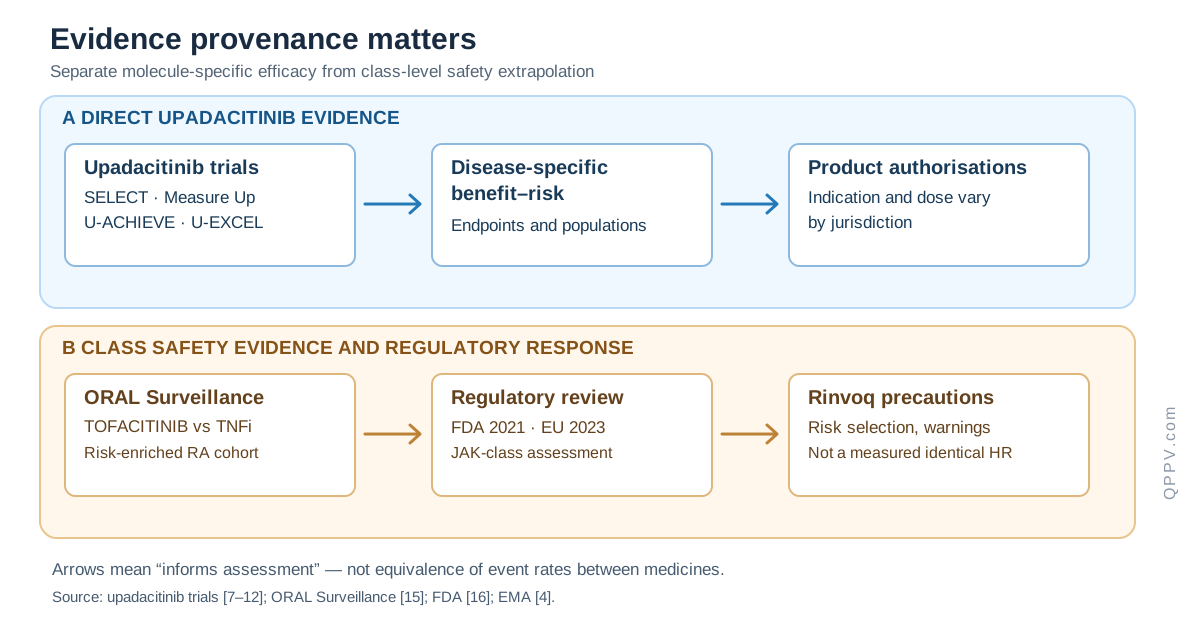
Figure 1. Upadacitinib's efficacy evidence is molecule-specific, whereas the pivotal comparative safety evidence was generated with tofacitinib and applied through a class-level regulatory review. The distinction matters for causality, risk communication and numerical interpretation.
Short-term efficacy trials with few serious events cannot rule out uncommon long-term outcomes. Conversely, class precautions do not establish that the numerical hazard ratios measured for tofacitinib are identical for upadacitinib. A pharmacovigilance assessment should record which evidence belongs to the product, which belongs to the class and which represents a precautionary regulatory inference.
6. Recognised adverse-reaction phenotypes
Infections and immune suppression
Serious infections are prominent in the US boxed warning and EU product information. They include bacterial, viral, fungal and opportunistic infections; tuberculosis and herpes zoster deserve particular attention [2,3]. Viral hepatitis reactivation is also described. Infection assessment should document microbiological evidence, site, severity, hospitalisation, treatment chronology, recent vaccination, immunosuppressant co-medication and underlying disease. A serious infection during treatment can have several contributors, including the disease itself and concurrent glucocorticoids.
Cardiovascular, thromboembolic and malignant events
A confirmed myocardial infarction, stroke, venous thrombosis or malignancy needs a phenotype-specific clinical chronology, not merely a temporal association. Record smoking, cardiovascular history, immobility, previous thrombosis, cancer history, inflammatory activity and co-treatment. In an older patient with giant-cell arteritis, the underlying vascular disease is itself relevant. Malignancy evaluation should include pathology, latency and screening history; distinguish non-melanoma skin cancer from other cancer endpoints [3,4].
Gastrointestinal perforation
Gastrointestinal perforation has been observed during upadacitinib development, including inflammatory-bowel-disease studies [3,11]. Diverticular disease, severe intestinal inflammation, corticosteroids and NSAIDs can complicate attribution. A useful report includes anatomical site, imaging or surgical confirmation, contemporaneous disease activity and other treatments. Do not convert every acute abdominal symptom into a confirmed perforation.
Haematology, liver tests and lipids
Neutropenia, lymphopenia, anaemia, increased liver enzymes and lipid changes are recognised monitoring issues [3,5,6]. The cited 2025 US prescribing information specifies interruption thresholds for low neutrophil, lymphocyte and haemoglobin measurements, and advises assessment when drug-induced liver injury is suspected. Those numerical thresholds belong to that product label; they should not be extrapolated to every JAK inhibitor or jurisdiction.
Laboratory follow-up should capture baseline results, the dose and sampling dates, trend after interruption, concomitant treatments and alternative diagnoses. Raised lipids are not synonymous with a documented cardiovascular event; isolated creatine-kinase elevation is not by itself evidence of rhabdomyolysis. For suspected hepatic injury, the pattern and clinical context matter more than a single unqualified 'LFT abnormal' entry.
Hypersensitivity and reproductive exposure
Anaphylaxis and angioedema are identified among serious hypersensitivity reactions in the US label [3]. Pregnancy and breastfeeding require separate benefit-risk assessment against the current local product information. When evaluating inadvertent pregnancy exposure, record timing relative to conception, other medicines, disease activity and pregnancy outcome. Animal reproductive findings should not be described as observed human malformation rates.
7. Pharmacokinetics, interactions and formulation errors
Upadacitinib is metabolised substantially through CYP3A4. Strong inhibitors can increase exposure, while strong inducers such as rifampin can reduce exposure and potentially compromise efficacy [3]. Dose-modification instructions are indication-dependent: the US label treats rheumatoid arthritis, atopic dermatitis and inflammatory bowel disease differently. A single generic interaction rule across all indications would be unsafe and scientifically inaccurate.
Pharmacodynamic interactions also matter. Combining JAK inhibitors with biologic DMARDs or potent immunosuppressants is not recommended in relevant US indications [3]. Medication reconciliation must identify the actual last dose of a previous therapy, overlap and background corticosteroids. An infection after a treatment switch cannot be evaluated properly without the entire immunosuppressant exposure history.
In the US, Rinvoq extended-release tablets and Rinvoq LQ oral solution are explicitly not substitutable [3]. The oral-solution regimen may be weight-dependent in paediatric patients. A safety case involving an apparent overdose, lack of efficacy or administration difficulty should preserve the formulation, strength, route, age/weight, dose instructions and dispensing record.
8. Practical pharmacovigilance assessment
A valid individual case safety report and a clinically complete case narrative are not the same thing. Once minimum reporting criteria are met under the applicable reporting system, follow-up should prioritise facts that change seriousness, diagnosis, causality, expectedness or risk management. Clinical uncertainty is recorded, not silently filled with assumptions.
| Suspected event | Information with high follow-up value | Key competing explanations |
|---|---|---|
| Serious infection | Organism, cultures, imaging, hospitalisation, immunosuppressants, TB/hepatitis history | Underlying disease, steroids, recent exposure to other immune therapies |
| MACE or thrombosis | Objective diagnosis, smoking and vascular history, immobility, treatment dates | Pre-existing vascular risk, inflammation, surgery, malignancy |
| Malignancy | Histology, diagnosis date, prior therapies, latency, screening history | Background cancer risk and previous immunosuppression |
| Gastrointestinal perforation | Anatomical site, imaging, surgery, bowel activity, NSAID/steroid exposure | Active inflammatory bowel disease, diverticulitis |
| Cytopenia or hepatic injury | Serial laboratory values, baseline, other medicines, infection work-up | Bone-marrow disorders, viral disease, other hepatotoxic medicines |
| Drug interaction or formulation error | Exact product, dose, strength, co-drugs, dispensing/administration record | Non-adherence, incorrect regimen, disease progression |
| Pregnancy exposure | Gestational dates, product, dose, maternal disease, outcome | Background reproductive risks and other exposures |
Illustrative case: serious infection during a treatment transition
A patient with refractory inflammatory bowel disease develops a serious infection shortly after beginning an upadacitinib induction regimen. The case record initially lists only the JAK inhibitor. Follow-up identifies recent high-dose corticosteroids and an overlapping biologic treatment. These findings do not exclude a contribution from upadacitinib; they materially change interpretation of the case and may identify a medication-transition problem. This is a hypothetical teaching example, not a reported regulatory case.
Illustrative case: pulmonary embolism
A patient receiving upadacitinib for an inflammatory disorder has imaging-confirmed pulmonary embolism. The patient recently underwent surgery and has a prior history of venous thrombosis. The event is clinically serious, but its attribution requires exposure timing, interruption status, risk-factor chronology and any available specialist assessment. The regulatory class warning remains relevant even when several causal contributors are plausible. This is a hypothetical case.
9. Signal detection, risk minimisation and governance
Product surveillance should combine spontaneous reports, literature, studies, product-quality complaints, medication errors and relevant regulatory actions. Disproportionality analysis may identify unusual reporting patterns but does not estimate event incidence or prove causality. Compare like with like: induction and maintenance exposure, indication, age group, duration, dose and concomitant immunosuppression. Aggregate case review should distinguish new clinical phenotypes from known reactions, shifts in severity and changes in exposed populations.
In the EU, the applicable SmPC, risk-management plan and authorised risk-minimisation materials determine the regulatory baseline [2,4]. The QPPV and safety organisation need documented signal decisions, traceable literature and case evaluations, governance of changes to reference safety information, and evidence that risk communications reach their intended audiences where required. These are operational examples; exact legal obligations and timelines must be checked against the current EU legislation and GVP for the relevant authorisation and procedure.
One governance failure is especially easy to create: copying the ORAL Surveillance tofacitinib percentages into an upadacitinib safety slide without their source drug, comparator and enriched-risk population. A second is silently applying the 2026 EU alopecia/vitiligo indications to a US 2025 product label. Both errors can distort the benefit-risk discussion and regulatory traceability.
10. Review checklist and final interpretation
For a new upadacitinib case or signal, first identify the active substance, exact formulation, indication, age/weight where relevant, dose phase and jurisdiction. Then reconstruct the medical timeline and previous immunosuppressive treatment; confirm the event phenotype and objective evidence; record cardiovascular, infectious, thrombotic or malignancy risk factors; evaluate dechallenge and alternatives; and compare the case with the current product-specific safety information. A class-wide warning should inform medical assessment without replacing the patient-specific causal analysis.
For an aggregate review, stratify by indication, induction versus maintenance, age and risk group before interpreting patterns. State whether each quantitative result came from an upadacitinib trial, another JAK-inhibitor trial, observational evidence or spontaneous reports. Record changes in authorisation and prescribing populations so that increased reporting after a new indication is not mistaken automatically for increased biological risk.
Key Takeaways
Upadacitinib emerged from AbbVie's ABT-494 programme and progressed from rheumatoid arthritis to multiple inflammatory indications through separate clinical programmes. Its preferential JAK1 activity does not imply risk-free immunosuppression. The EU product information updated in October 2026 includes newer alopecia-areata and vitiligo indications that must not be projected onto an older US label. Serious infections, malignancy, cardiovascular and thromboembolic concerns, gastrointestinal perforation, laboratory effects, interactions and formulation errors require indication-aware assessment. The most important safety-evidence discipline is to preserve the difference between direct upadacitinib evidence and the tofacitinib-based class review.
References
- Parmentier JM, et al. In vitro and in vivo characterization of the JAK1 selectivity of upadacitinib (ABT-494). BMC Rheumatol. 2018;2:23. https://doi.org/10.1186/s41927-018-0031-x
- European Medicines Agency. Rinvoq (upadacitinib): EPAR, authorised indications and EU product information. Product information updated 13 October 2026. https://www.ema.europa.eu/en/medicines/human/EPAR/rinvoq
- US Food and Drug Administration. Rinvoq/Rinvoq LQ: US Prescribing Information. 2025 label, including October 2025 major changes; product-specific prescribing source. https://www.accessdata.fda.gov/drugsatfda_docs/label/2025/211675Orig1s028,218347Orig1s005lbl.pdf
- European Medicines Agency. Janus kinase inhibitors (JAKi): Article 20 referral and risk-minimisation decision. European Commission decision 10 March 2023. https://www.ema.europa.eu/en/medicines/human/referrals/janus-kinase-inhibitors-jaki
- Kremer JM, et al. A Phase IIb Study of ABT-494, a Selective JAK-1 Inhibitor, in Patients With Rheumatoid Arthritis and an Inadequate Response to Anti-Tumor Necrosis Factor Therapy. Arthritis Rheumatol. 2016;68:2867–2877. https://doi.org/10.1002/art.39801
- Genovese MC, et al. Efficacy and Safety of ABT-494 in Patients With Rheumatoid Arthritis and an Inadequate Response to Methotrexate. Arthritis Rheumatol. 2016. https://doi.org/10.1002/art.39808
- Fleischmann R, et al. Upadacitinib Versus Placebo or Adalimumab in Patients With Rheumatoid Arthritis and an Inadequate Response to Methotrexate: SELECT-COMPARE. Arthritis Rheumatol. 2019;71:1788–1800. https://doi.org/10.1002/art.41032
- van Vollenhoven R, et al. Efficacy and Safety of Upadacitinib Monotherapy in Methotrexate-Naive Patients With Rheumatoid Arthritis: SELECT-EARLY. Arthritis Rheumatol. 2020. https://pubmed.ncbi.nlm.nih.gov/32638504/
- Guttman-Yassky E, et al. Once-daily upadacitinib versus placebo in moderate-to-severe atopic dermatitis (Measure Up 1 and 2). Lancet. 2021;397:2151–2168. https://doi.org/10.1016/S0140-6736(21)00588-2
- Danese S, et al. Upadacitinib induction and maintenance therapy for moderately to severely active ulcerative colitis: three phase III trials. Lancet. 2022;399:2113–2128. https://doi.org/10.1016/S0140-6736(22)00581-5
- Loftus EV Jr, et al. Upadacitinib Induction and Maintenance Therapy for Crohn's Disease. N Engl J Med. 2023;388:1966–1980. https://doi.org/10.1056/NEJMoa2212728
- Blockmans D, et al. A Phase 3 Trial of Upadacitinib for Giant-Cell Arteritis. N Engl J Med. 2025;392:2013–2024. https://doi.org/10.1056/NEJMoa2413449
- AbbVie. European Commission approval announcement: upadacitinib for severe alopecia areata. 29 July 2026. https://news.abbvie.com/2026-07-29-AbbVie-Announces-European-Commission-Approval-of-RINVOQ-R-upadacitinib-for-the-Treatment-of-Adults-and-Adolescents-with-Severe-Alopecia-Areata
- AbbVie. European Commission approval announcement: upadacitinib for non-segmental vitiligo. 29 July 2026. https://news.abbvie.com/2026-07-29-AbbVie-Announces-European-Commission-Approval-of-RINVOQ-R-upadacitinib-for-the-Treatment-of-Adults-and-Adolescents-with-Non-Segmental-Vitiligo
- Ytterberg SR, et al. Cardiovascular and Cancer Risk with Tofacitinib in Rheumatoid Arthritis (ORAL Surveillance). N Engl J Med. 2022;386:316–326. https://doi.org/10.1056/NEJMoa2109927
- US Food and Drug Administration. FDA requires warnings about increased risk of serious heart-related events, cancer, blood clots and death for JAK inhibitors. Safety communication 1 September 2021, label implementation update December 2021. https://www.fda.gov/drugs/drug-safety-and-availability/fda-requires-warnings-about-increased-risk-serious-heart-related-events-cancer-blood-clots-and-death
Regulatory Note
Educational lifecycle review prepared 22 October 2026. The EU EPAR was checked against its 13 October 2026 product-information update and the US prescribing document cited is a 2025 label; these are not guaranteed to remain current. Authorised uses, formulations, dose rules, warnings and risk-minimisation materials differ across jurisdictions and revisions. Binding product information, regulator-led class recommendations, primary trial results, scientific interpretation and illustrative operational practice have been distinguished throughout. The hypothetical cases are not real individual safety reports, and the numerical outcomes of ORAL Surveillance are explicitly attributable to tofacitinib, not upadacitinib.