Tafamidis: Discovery, Development, Safety and Pharmacovigilance
Tafamidis is a small-molecule transthyretin (TTR) stabiliser developed to slow the formation of amyloid from an otherwise functional transport protein. Its history is unusually instructive for pharmacovigilance: a mechanistically persuasive intervention was first evaluated in hereditary amyloid polyneuropathy, where the pivotal study did not meet both prespecified co-primary endpoints in its intention-to-treat analysis, before a separate, larger cardiomyopathy programme demonstrated a survival benefit. Today's product labels also differ by salt, formulation, indication and jurisdiction. A case that identifies only the brand family can therefore be medically ambiguous [1–5].
- Tafamidis: Discovery, Development, Safety and Pharmacovigilance
- 1. Disease mechanism: the unstable transthyretin tetramer
- 2. Discovery: a protein-folding strategy becomes a medicine
- 3. Translating mechanism into clinical outcomes
- 4. The neuropathy programme
- 5. ATTR-ACT: testing clinical benefit in cardiomyopathy
- 6. A mechanism figure: stabilisation is upstream of organ injury
- 7. The 2026 regulatory landscape: one INN, several distinct products
- 8. Safety profile: separate treatment effects from amyloid disease
- 9. Case assessment: an operational framework for tafamidis
- 10. Risk minimisation, surveillance and inspection readiness
- 11. Practical review checklist
- Key Takeaways
- References
- Regulatory Note
1. Disease mechanism: the unstable transthyretin tetramer
Transthyretin is a circulating transport protein assembled from four subunits. Its native tetramer can dissociate into monomers that misfold and form amyloid fibrils. Deposits may affect peripheral nerves, autonomic function or the myocardium. Variant ATTR results from pathogenic TTR variants; wild-type ATTR develops without such a pathogenic variant, often later in life. Amyloid light-chain (AL) disease has a different precursor protein and requires a different diagnostic and therapeutic approach [1,2].
The rate-limiting dissociation of the tetramer offered a therapeutic target: stabilising the native protein could slow the supply of aggregation-prone monomers. Tafamidis binds at TTR thyroxine-binding sites, increasing tetramer stability. It is a stabiliser, not a TTR gene-silencing therapy, a fibril-removing treatment or a replacement for supportive care. This mechanism explains the rationale for early intervention but does not prove that established cardiac or neurological damage will reverse [1,6].
2. Discovery: a protein-folding strategy becomes a medicine
Research led by Jeffery Kelly and colleagues explored kinetic stabilisation as a strategy for protein-misfolding diseases. The early-2000s medicinal-chemistry work on benzoxazole derivatives supplied a scientific foundation for tafamidis development [6,7]. The development programme subsequently passed through FoldRx and Pfizer. Corporate history matters here to trace the development and regulatory evidence, not to treat company promotion as independent proof of efficacy.
The European Union first authorised Vyndaqel for selected hereditary TTR amyloid polyneuropathy in 2011. In May 2019, the United States authorised tafamidis products for adult transthyretin amyloid cardiomyopathy following the ATTR-ACT programme [1,8]. The 2011 neuropathy authorisation and the 2019 US cardiomyopathy authorisation relied on different clinical populations and endpoints. Neither is evidence that every form of systemic amyloidosis responds to tafamidis.
3. Translating mechanism into clinical outcomes
TTR stabilisation can be measured pharmacodynamically, but a laboratory demonstration of stabilisation is not equivalent to preserved walking ability, improved neuropathy or longer survival. Clinical benefit must be tested in the relevant organ disease and stage. For neuropathy, disability and quality-of-life measures are important; for cardiomyopathy, mortality, cardiovascular hospitalisation, functional capacity and patient-reported health status provide distinct perspectives [3,4].
This distinction also matters after marketing. A patient whose heart failure progresses during tafamidis treatment may have progression of a serious underlying disease, not necessarily a drug-induced event or a lack of pharmacological binding. The assessment requires baseline disease stage, objective follow-up and a plausible chronology, while remaining alert to true adverse reactions and product-use errors.
4. The neuropathy programme
The pivotal Fx-005 study randomised 128 patients with early hereditary ATTR polyneuropathy to tafamidis or placebo for 18 months. Its intention-to-treat population included 125 participants [3].
Neither prespecified co-primary endpoint achieved conventional statistical significance. The NIS-LL responder proportions were 45.3% versus 29.5% (p=0.068), and Norfolk quality-of-life changes were 2.0 versus 7.2 (p=0.116). Secondary measures and analyses of evaluable participants favoured tafamidis, but they do not convert unmet primary endpoints into met endpoints [3].
The 2011 European authorisation for stage 1 symptomatic polyneuropathy was a regulatory benefit–risk decision informed by the totality of evidence [1,2]. The US cardiomyopathy indication does not extend to ATTR polyneuropathy [10].
5. ATTR-ACT: testing clinical benefit in cardiomyopathy
The 2018 ATTR-ACT trial addressed a different disease manifestation from Fx-005. It enrolled 441 adults with wild-type or hereditary transthyretin amyloid cardiomyopathy and randomised them for 30 months to tafamidis meglumine 80 mg daily (176 participants), 20 mg daily (88), or placebo (177). The prespecified primary analysis pooled the two tafamidis groups and used a hierarchical Finkelstein–Schoenfeld comparison: all-cause mortality had priority over the frequency of cardiovascular hospitalisation. This design is important because a patient who dies early cannot subsequently be hospitalised; a simple count of admissions can therefore misrepresent benefit [4].
The pooled tafamidis group had 78 deaths among 264 participants (29.5%), compared with 76 among 177 (42.9%) receiving placebo. The reported hazard ratio for all-cause mortality was 0.70 (95% CI 0.51–0.96). Cardiovascular-related hospitalisation rates were 0.48 versus 0.70 per patient-year, respectively (relative rate ratio 0.68, 95% CI 0.56–0.81). The hierarchical primary comparison favoured tafamidis (p<0.001). Decline in six-minute walk distance and Kansas City Cardiomyopathy Questionnaire overall score was also less pronounced with tafamidis [4]. These are randomised trial results for ATTR-CM, not evidence that tafamidis reverses established myocardial deposits or is effective in AL amyloidosis.
The pooled primary comparison should not be rewritten as a separately proven mortality effect of the currently marketed 61 mg capsule, nor should the two trial doses be represented as interchangeable milligram strengths. ATTR-ACT used tafamidis meglumine capsules; later tafamidis 61 mg formulations were supported by pharmacokinetic bridging and the regulatory benefit–risk assessment [2,4,10]. A published analysis comparing trial dose groups and long-term extension outcomes adds context but does not replace the prespecified pooled comparison [11].
Interpreting disease stage and competing outcomes
At baseline, ATTR-ACT included patients in New York Heart Association (NYHA) functional classes I–III, not class IV. The observed cardiovascular-hospitalisation rate in the baseline NYHA III subgroup was higher with tafamidis than placebo even though the overall trial favoured treatment. One explanation is survivor bias: patients who live longer remain at risk of subsequent admissions. A later post-hoc analysis accounting for the competing event of death explored this possibility, but it must not be mistaken for a new confirmatory randomised trial [4,12].
This creates a general pharmacovigilance lesson. In a progressive and potentially fatal disease, worsening dyspnoea, hospitalisation, syncope and death may represent underlying disease, treatment failure, adverse reactions, or combinations of these. A temporal sequence alone cannot separate them. The safety assessor needs baseline stage, treatment duration, relevant investigations and other therapies. Likewise, a longer period alive with heart failure can produce more opportunities to observe adverse events without implying that treatment caused the underlying illness.
Long-term extensions: useful, but not a second placebo-controlled trial
Patients continuing from ATTR-ACT could enter an open-label extension. Reports of longer-term outcomes and comparisons of earlier versus later tafamidis initiation support continued evaluation of durability, but extension cohorts are affected by survival to enrolment, treatment crossover and changes in supportive care [11]. Such analyses may inform clinical interpretation and signal evaluation; they do not recreate random allocation after crossover.
Tafamidis is one of several mechanistically distinct approaches now used or studied in ATTR disease. Other stabilisers and TTR-directed RNA-silencing therapies should be evaluated against their own product labels and clinical evidence. Combining treatment classes, where clinically considered, raises new exposure-attribution questions; results for another active substance must not be assigned to tafamidis [1,2].
6. A mechanism figure: stabilisation is upstream of organ injury
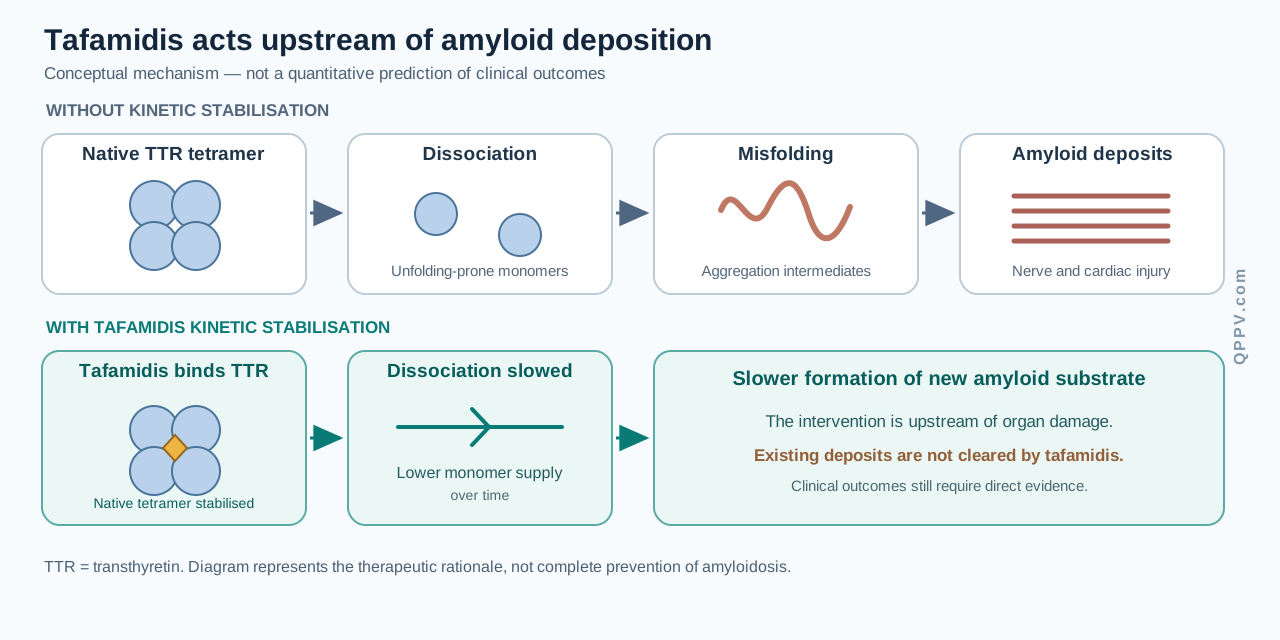
Figure 1. Conceptual kinetic-stabilisation pathway. Tafamidis binds the native TTR tetramer and slows its dissociation, the rate-limiting step leading to amyloid-forming species. The drawing is not a quantitative molecular model: it does not imply complete prevention of aggregation, removal of pre-existing deposits, or reversal of organ damage [2,6,7].
TTR tetramer dissociation, monomer misfolding and amyloid deposition are successive biological processes, but clinical outcomes depend on more than any one reaction rate. The value of the figure is to locate the intervention upstream of deposited amyloid. That placement explains why pharmacodynamic stabilisation is not a surrogate for restored nerve or cardiac function and why disease progression during treatment deserves careful assessment rather than a reflex attribution to drug toxicity.
7. The 2026 regulatory landscape: one INN, several distinct products
Tafamidis presents a practical example of why an INN-level safety review must not erase product-specific authorisations. The EU Vyndaqel product information revised in August 2026 contains three presentations, but they do not all have the same therapeutic indication. A 61 mg film-coated tablet was added after the June 2026 CHMP positive opinion and subsequent Commission procedure. Its EU indication is specifically wild-type ATTR cardiomyopathy; the 61 mg soft capsule continues to cover wild-type and hereditary ATTR cardiomyopathy [1,2,5]. The difference is not a typographical curiosity: genotype and formulation can determine whether the reported use is within the particular product's label.
| Product and region (October 2026 source check) | Active substance and presentation | Authorised clinical scope in cited source |
|---|---|---|
| EU Vyndaqel 20 mg soft capsule | Tafamidis meglumine 20 mg (equivalent to 12.2 mg tafamidis) | Adult stage 1 symptomatic ATTR polyneuropathy |
| EU Vyndaqel 61 mg soft capsule | Tafamidis 61 mg | Adult wild-type or hereditary ATTR cardiomyopathy |
| EU Vyndaqel 61 mg film-coated tablet | Tafamidis 61 mg | Adult wild-type ATTR cardiomyopathy only |
| EU Tafamidis Accord capsule | Tafamidis; check authorised pack | Adult hereditary ATTR cardiomyopathy under its own authorisation |
| US Vyndaqel 20 mg capsule | Tafamidis meglumine; labelled CM regimen uses four capsules daily | Adult wild-type or hereditary ATTR cardiomyopathy |
| US Vyndamax 61 mg capsule | Tafamidis 61 mg | Adult wild-type or hereditary ATTR cardiomyopathy |
Table 1. Authorisation is presentation- and jurisdiction-specific. The EU Tafamidis Accord generic authorisation was issued on 18 September 2026; it is not an authorisation for all tafamidis indications. The table is a regulatory comparison, not an instruction to substitute medicines [1,2,9,10].
The 20 mg tafamidis meglumine capsule and 61 mg tafamidis capsule/tablet are not substitutable milligram for milligram. The cardiomyopathy exposure associated with 80 mg tafamidis meglumine is achieved by the corresponding 61 mg tafamidis formulation; this is a product-specific bridging relationship, not an arithmetic equivalence between the numerical strengths. The EU film-coated tablet SmPC states that no dose adjustment is required when changing from its 61 mg soft capsule to its 61 mg tablet, but that statement does not broaden the tablet's narrower authorised genotype indication [2]. Confirm the applicable national presentation and instructions before any change.
A second important difference is regulatory geography. The current US DailyMed label covers ATTR cardiomyopathy for Vyndaqel and Vyndamax, not ATTR polyneuropathy [10]. The EU Vyndaqel 20 mg capsule's neuropathy indication therefore cannot be copied into a US product description. Nor should the existence of an EU generic be described as proof of commercial availability in every Member State.
Establishing the right disease before exposure attribution
ATTR cardiomyopathy can coexist with or resemble other causes of heart failure. The EU cardiomyopathy SmPC requires an appropriate aetiological diagnosis and specifically calls for excluding AL amyloidosis and characterising wild-type versus hereditary TTR [2]. Bone scintigraphy, blood and urine monoclonal-protein investigations, biopsy where appropriate and genotyping have distinct diagnostic roles. A positive cardiac imaging finding without the required differential assessment should not be treated as complete evidence of the labelled diagnosis.
For a PV case involving a suspected indication or medication error, record the diagnostic subtype actually established, not only the clinician's working label. Where a genetic result is unknown, retain that uncertainty. Do not classify a patient as wild-type simply because no family history was documented.
8. Safety profile: separate treatment effects from amyloid disease
The randomised cardiomyopathy trial did not reveal a large overall adverse-event excess: the frequency and types of events were broadly similar between tafamidis and placebo [4,10]. That does not mean every suspected reaction is impossible or that spontaneous reports should be dismissed. In the 2026 EU 61 mg soft-capsule product information, diarrhoea, rash and pruritus appear as common adverse reactions; flatulence and increased liver function tests were observed more often than placebo in the referenced high-dose study, without an established causal relationship for those two observations [2]. The 20 mg neuropathy capsule has a different trial population and its own listed reactions, including urinary tract infection, diarrhoea and upper abdominal pain. Do not pool these denominators as though they were one safety trial.
The EU SmPC describes possible increased liver function tests and decreased total thyroxine. The thyroxine observation may reflect altered binding to transthyretin and can occur without a corresponding change in free T4 or TSH or clinical hypothyroidism [2]. A case narrative should report the actual laboratory pattern, symptoms and clinical diagnosis. It should not automatically code isolated low total T4 as clinically manifest thyroid dysfunction.
Cardiac failure, oedema, fatigue, arrhythmia, falls and death may arise from ATTR cardiomyopathy itself, comorbidity or treatment context. For a suspected adverse reaction, record the event definition, objective findings, baseline severity, co-exposures, competing causes and clinical course. In particular, a death during treatment is not by itself evidence that tafamidis increased mortality; randomised trial results provide an essential but not exhaustive context.
Interactions: BCRP matters more than an invented CYP warning
Tafamidis inhibits the breast cancer resistance protein (BCRP) transporter in vitro. A clinical interaction study found approximately twofold higher rosuvastatin exposure after repeated tafamidis 61 mg administration. The EU SmPC recommends monitoring for adverse reactions to BCRP substrates and considering substrate dose reduction where appropriate; it lists examples including rosuvastatin, methotrexate and certain other medicines [2]. The US label likewise identifies BCRP substrate interactions [10]. For a suspected statin-associated muscle reaction, the assessor should record the statin, dose, tafamidis formulation, temporal overlap, symptoms, CK findings if available and alternative causes. Do not describe this as a proven CYP3A4 induction effect.
In-vitro OAT1/OAT3 inhibition has also been described, but the EU product information does not predict clinically significant exposure changes for those substrates at the cited doses [2]. It would be misleading to elevate every in-vitro interaction to an established clinical risk. Conversely, a normal baseline laboratory result does not rule out a subsequently observed clinical event.
Reproductive safety and special populations
EU product information recommends contraception during tafamidis treatment and for one month after discontinuation, advises against use during pregnancy, and states that tafamidis should not be used during breastfeeding; these precautions reflect animal developmental findings and limited human pregnancy evidence [2]. The US label similarly warns of potential fetal harm and advises against breastfeeding [10]. In the EU, additional risk-minimisation materials address pregnancy prevention and surveillance [1].
No general paediatric indication is established. Severe hepatic impairment has limited or absent clinical data; severe renal impairment is also an evidence gap rather than proof of a new dose regimen [2]. EU and US contraindication headings differ: the EU SmPC lists hypersensitivity to tafamidis or excipients, while the cited US label states no contraindications. That regulatory wording must be quoted by jurisdiction, not collapsed into one global statement [2,10].
9. Case assessment: an operational framework for tafamidis
The central question is not merely whether an event followed tafamidis exposure. It is whether the evidence distinguishes a suspected adverse reaction, disease progression, medication error, interaction, product-quality issue or uncertain attribution. ATTR is a multisystem condition, and treatment often occurs in older patients receiving diuretics, anticoagulants, statins and other cardiovascular medicines. The drug and the disease therefore share clinical territory.
A useful intake record begins with the minimum case-validity elements under the applicable reporting framework, then seeks clinically discriminating follow-up. The fields below are recommended medical follow-up, not new ICSR validity requirements or invented submission timelines [13].
| Reported concern | High-value follow-up | Common attribution trap |
|---|---|---|
| Worsening heart failure or hospitalisation | ATTR subtype, NYHA class, baseline NT-proBNP/echo where available, admission diagnosis, treatment history | Treating progression of established cardiac amyloidosis as a proven adverse reaction |
| Death or serious arrhythmia | Cause of death, rhythm evidence, baseline cardiac status, other treatments, competing causes | Assuming temporal association equals causation |
| Rash or diarrhoea | Clinical description, onset, severity, concomitant medicines, treatment interruption and outcome | Assuming every event is a characteristic class effect |
| Liver test abnormality | Serial ALT/AST/bilirubin, baseline values, alcohol/viral/metabolic causes, co-medication | Confusing an observed laboratory abnormality with proven drug-induced liver injury |
| Low total thyroxine | Free T4, TSH, symptoms and treatment history | Coding isolated binding-related total-T4 change as hypothyroidism |
| Suspected BCRP interaction | Rosuvastatin or other substrate identity, dose, exposure overlap, clinical/laboratory findings | Assuming all statins have the same measured interaction magnitude |
| Pregnancy exposure | Gestational dates, formulation, duration, other exposures, outcome and follow-up | Treating an animal finding as an observed human malformation rate |
| Formulation/indication mismatch | Country, package, batch, salt, form, strength, genotype and prescribed regimen | Treating all 61 mg products as having the same authorisation |
Illustrative case: cardiac deterioration during treatment
A patient with confirmed hereditary ATTR-CM has worsening breathlessness and is hospitalised several months after starting tafamidis. This hypothetical report merits a structured evaluation of pre-treatment NYHA class, cardiac biomarkers, echocardiography, treatment continuity, other causes of decompensation and any suspected adverse reaction. The outcome may be progression despite disease-modifying treatment; the assessor should not silently convert it to a labelled tafamidis toxicity or dismiss a potentially important safety signal.
Illustrative case: wrong formulation for a documented genotype
A patient with hereditary ATTR-CM receives an EU 61 mg film-coated Vyndaqel tablet after previously receiving the 61 mg soft capsule. The two presentations contain tafamidis, and the EU tablet label provides a no-dose-adjustment statement for a formulation change. However, the tablet's authorised indication is restricted to wild-type ATTR-CM [2]. The case should therefore capture the country, actual presentation, genotype, prescribing rationale, any associated harm and the relevant medication-error or off-label-use categorisation. A lack of reported harm does not make the regulatory distinction disappear.
Illustrative case: laboratory and transporter signals
A patient receiving tafamidis 61 mg and rosuvastatin reports new muscle pain, with a concurrent low total T4 result. The BCRP interaction warrants assessment of statin exposure and muscle injury, while the thyroid findings require free T4, TSH and symptoms before a thyroid disorder is diagnosed. Two laboratory observations in one report may have different mechanisms and causal interpretations [2,10]. This is a hypothetical learning case, not a documented adverse reaction.
10. Risk minimisation, surveillance and inspection readiness
The EMA lists Vyndaqel under additional monitoring and describes educational materials concerning pregnancy avoidance, pregnancy surveillance and confirmation of ATTR-CM before treatment [1]. Additional monitoring is a regulatory mechanism to encourage detection and reporting of suspected reactions; it is not a declaration that the product is inherently less safe than other medicines. The relevant risk-management plan and national implementation should be consulted for actual obligations.
For a marketing-authorisation holder, useful operational controls include a current product/formulation matrix, standardised case intake fields, a pathway to reconcile brand and active-substance identities, medically appropriate follow-up templates, and checks that local patient materials match the authorised presentation. Quality review should be able to demonstrate how a reported genotype mismatch, formulation error, pregnancy exposure or suspected interaction was evaluated and, where appropriate, escalated.
EU GVP provides the broader framework for collecting and evaluating reports, duplicate handling, signal management and risk minimisation. The EMA notes that certain GVP material is being updated following newer ICH guidance; current implementation documents should be checked rather than assuming an older chapter resolves every contemporary classification question [13]. This article does not substitute a local reporting procedure or assert a single reporting deadline for every event type.
A signal evaluation should stratify by indication, country, presentation and exposure context where the data permit. Raw EudraVigilance or FAERS counts are not rates, and disproportionality alone cannot establish causation. In a disease with high background mortality, an increase in reported heart-failure events may reflect uptake among sicker patients, changes in recognition of ATTR-CM, or a true concern requiring investigation. The appropriate response is medical review, triangulation with clinical and epidemiological evidence, and documented benefit–risk reasoning.
11. Practical review checklist
Before closing a medically important tafamidis case or approving a product-level safety summary, verify that the record distinguishes the exact presentation and jurisdiction, ATTR genotype and organ phenotype, baseline severity and competing causes, co-medication and interaction context, and outcome with clinically relevant investigations. Confirm that the chosen reference label is current for the marketed product. When conclusions are uncertain, document the uncertainty and the information still needed.
Key Takeaways
Tafamidis is a TTR kinetic stabiliser, not an amyloid-removing treatment. Its development demonstrates why biological plausibility, a pharmacodynamic marker and a positive clinical endpoint are different levels of evidence. Fx-005 did not meet its two prespecified co-primary endpoints in the ITT analysis; ATTR-ACT subsequently showed clinically meaningful cardiomyopathy benefit in a different population [3,4].
In 2026, EU 20 mg meglumine soft capsules, 61 mg tafamidis soft capsules, 61 mg tafamidis film-coated tablets, and Tafamidis Accord have distinct authorised scopes. US Vyndaqel and Vyndamax are also product-specific [2,9,10]. Safe pharmacovigilance requires precise product identity, recognition of progressive disease as a competing explanation, attention to BCRP interactions and reproductive risk minimisation, and a traceable route from individual reports to aggregate benefit–risk review.
References
- European Medicines Agency (EMA). Vyndaqel: European public assessment report (EPAR). Updated 14 October 2026. https://www.ema.europa.eu/en/medicines/human/EPAR/vyndaqel
- EMA. Vyndaqel: EPAR product information, Annex I, including 20 mg meglumine soft capsules, 61 mg tafamidis soft capsules and 61 mg film-coated tablets. Updated 27 August 2026. https://www.ema.europa.eu/en/documents/product-information/vyndaqel-epar-product-information_en.pdf
- Coelho T, et al. Tafamidis for transthyretin familial amyloid polyneuropathy: a randomized, controlled trial. Neurology. 2012;79:785–792. doi:10.1212/WNL.0b013e3182661eb1. https://pubmed.ncbi.nlm.nih.gov/22843282/
- Maurer MS, et al. Tafamidis Treatment for Patients with Transthyretin Amyloid Cardiomyopathy. N Engl J Med. 2018;379:1007–1016. doi:10.1056/NEJMoa1805689. https://pubmed.ncbi.nlm.nih.gov/30145929/
- EMA. Vyndaqel: positive CHMP opinion on new 61 mg film-coated formulation. 25 June 2026; subsequently reflected in updated product information. https://www.ema.europa.eu/en/medicines/human/variation/vyndaqel
- Bulawa CE, et al. Tafamidis, a potent and selective transthyretin kinetic stabilizer that inhibits the amyloid cascade. PNAS. 2012;109:9629–9634. doi:10.1073/pnas.1121005109. https://pubmed.ncbi.nlm.nih.gov/22645360/
- Razavi H, et al. Benzoxazoles as Transthyretin Amyloid Fibril Inhibitors: Synthesis, Evaluation, and Mechanism of Action. Angew Chem Int Ed. 2003;42:2758–2761. doi:10.1002/anie.200351179. https://doi.org/10.1002/anie.200351179
- US FDA. Vyndaqel (tafamidis meglumine) and Vyndamax (tafamidis): original US prescribing information. 2019. https://www.accessdata.fda.gov/drugsatfda_docs/label/2019/211996s000%2C212161s000lbl.pdf
- EMA. Tafamidis Accord: EPAR. European Commission marketing authorisation 18 September 2026; EPAR updated 8 October 2026. https://www.ema.europa.eu/en/medicines/human/EPAR/tafamidis-accord
- US National Library of Medicine, DailyMed. Vyndaqel (tafamidis meglumine) and Vyndamax (tafamidis): US prescribing information. DailyMed label updated 12 May 2026. https://dailymed.nlm.nih.gov/dailymed/drugInfo.cfm?setid=1b4121ee-a733-4456-a917-be2603477839
- Damy T, et al. Efficacy and safety of tafamidis doses in ATTR-ACT and the long-term extension study. Eur J Heart Fail. 2021. https://pmc.ncbi.nlm.nih.gov/articles/PMC8048553/
- Sultan MB, et al. Estimating the effect of tafamidis on cardiovascular-related hospitalization in NYHA class III patients in the presence of death. 2022. https://pubmed.ncbi.nlm.nih.gov/35853436/
- EMA. Good pharmacovigilance practices (GVP): current modules and implementation notes, including Module VI and signal management. Accessed 23 October 2026. https://www.ema.europa.eu/en/human-regulatory-overview/post-authorisation/pharmacovigilance-post-authorisation/good-pharmacovigilance-practices-gvp
Regulatory Note
Evidence and label review date: 23 October 2026. Product authorisation is jurisdiction-, formulation- and indication-specific; the table describes the identified EU and US sources, not universal prescribing permission or country-level availability. Historical trials, current product information, EMA guidance and recommended PV follow-up have different evidentiary and legal status. Numerical trial findings should not be generalised beyond their analysed populations. The case examples are hypothetical. Clinical decisions and statutory reporting should use the current applicable local label and requirements.